Sunday, January 23, 2011

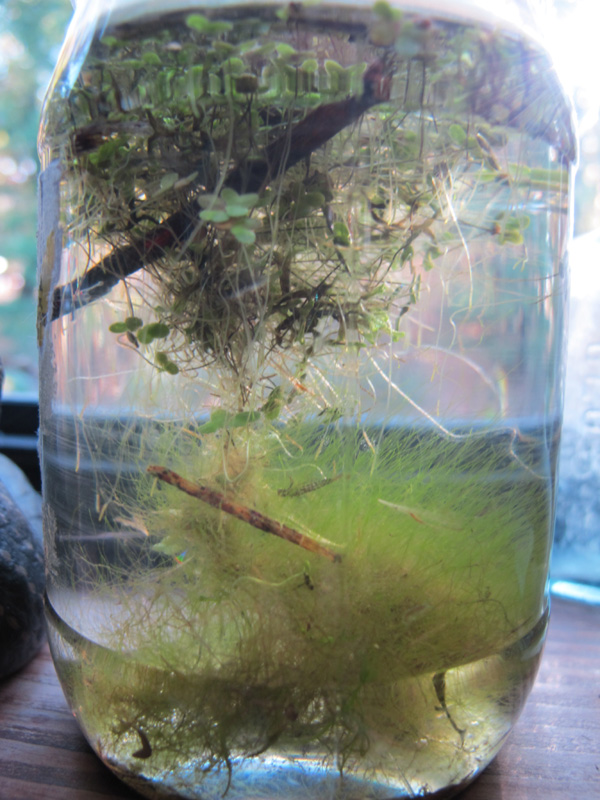
Plants and other green stuff in the pond sample


In order for my pond sample to be healthy I included some green stuff to provide oxygen. I had no idea what they were at the time but they were green so I figured, like vegetables on my plate, they are good to include.

Lemna minor (Lesser Duckweed)

The floating tiny Lilly pad looking plants are Duckweeds from the Lemnaceae family. They float on the surface of the water with a single root hanging down.

When I collected the water from Altona Marsh, my jar and hand was covered with them. I have seen them so thick on some ponds that you cannot see the water below. In situations like that they shut out the light and the plants below die along with the herbivorous insects that feed on them. Yet, they can also be a good tool for filtering and cleaning water. From what I read there is still a lot of research going to find ways to use them to clean up the environment.


I think what I have in my sample is Lemna minor (Lesser Duckweed). The common name Duckweed comes from observing ducks feeding on these tiny plants. They are high in protein, more than soybeans and are eaten by people in some cultures. Since they stick so well to my fingers I imagine that they stick well to ducks feet and are thus transported from pond to pond.

Another plant I think I have identified in the water is a Liverwort called Riccia fluitans. They grow just below the surface as you can see here. The branched thallus is darker green and thicker than the duckweed. They will also grow on damp soil and in that case, according to Ann Morgan (Field Book of Ponds and Steams), they can be reddish or purplish. Her book was written in 1930 so I wouldn’t swear by it but you can bet that the next time I go to Altona Marsh I will be looking.

Riccia fluitans
A third plant I have in the jar, I believe is a green alga species in the genus Chara called Chara vulgaris. What I’m talking about is the plant that has a defined stem and a whorl of leaf like structures along the stem as pictured below.

Chara vulgaris

There are lots of algae in the jar as well. The long stringy algae might be Zygnema species.

Zygnema species

Desmids are green algae cells that are often found in bogs similar to Altona Marsh where I found these. This crescent-shaped one is a Closterium.

Closterium

Below are some other shapes of algae that I found. Even though I don’t know what they are now I find them totally fascinating to look and loads of fun to find.


You can see some Diatoms in the photo above as well as algae.

Wednesday, January 19, 2011

Damselfly nymph in winter


At the end of October I took a walk to Altona Marsh and collected some of the water along the track.


I just filled up two plastic peanut butter jars and made sure I had some duckweed, algae, sediment from the bottom and bits of other stuff. I didn’t really look to see what I had. With two jars I was sure to get something interesting.

Sure enough, after the water settled for a few hours I was able to see an Odonata nymph. The three leaf-shaped gills extending from the hind end of the body indicates that it is a damselfly. I haven’t a clue what species this is. They overwinter as nymphs and emerge in late spring. They are very predacious and eat every kind of aquatic insect, small crustaceans and snails so I think there will be plenty of food in this one jar for a while. I have actually seen a few things disappear since March and I suspect this is the culprit. Most of the time it just sits and waits for a victim to come by.

I soon realized that I was going to get distorted photos from the jar so I bought a small rectangular plastic tank which made it easier to get close up with my camera. Just recently I took the photo below. I think it must have molted because it is so clear and you can see the insides. Earlier it was emerald green. They molt between 6-15 times. With each instar the nymph get darker in color. Now you can clearly see the tracheal gills and tracheae and lines with the consequent flowing of the blood throughout. I think the darker part in the middle is its heart.


You might be able to make out the labium that looks like its chin. When it is ready to catch something the labium flies out with the swiftness of a frogs tongue and grabs it’s pray and snaps it back into its mouth. I watched it stick part of it out and place its front legs up as though it were cleaning the tip. I wasn't quick enought to get a photo but here is another view.


When I turned the container around it would bend its body to move the tail in my direction. I wonder if that was some sort of defense action. It did it several times.


They move about slowly by crawling or swaying like a fish by sweeping their tail from side to side. It has been really fun to watch especially as the snow falls.

Check out other blogs about water at Watery Wednesday.

Friday, January 14, 2011

Poecile carolinensis window strike

This year I have been participating in the West Virginia Winter Bird Count so I have been very good about keeping my feeders full of goodies. When I checked on them the other day I noticed a little Carolina Chickadee (Poecile carolinensis) was laying face down on the deck just outside the glass door. My heart just dropped but when I picked it up I could tell it was still alive. I folded its wing back in place and held it cupped in my hand for a few minutes.

The chickadee looked stunned and in a daze. I checked the door and sure enough there were a few feathers stuck on the glass.


As it sat in my hand, it's mouth opened and closed as if calling but nothing came out. My first thought was that it was trying to catch its breath but in truth I have no idea what was going on with it's mouth. I brought it into the house with me to get my camera so I could take these photos. Back outside, I placed it on an old bird house I had sitting at the side of the deck and took lots of photos.


That seemed like a safe place and it could see the other birds and have the freedom to fly. It;'s foot was a little crumpled but eventually straightened out.

Once I went back inside a couple other chickadees flew to the feeders. You know how they are always the first to return, besides I had meal worms spread out for them. I noticed the stunned chickadee began to look in their direction so I could tell it was coming back into awareness. It sat there for a while but each time a bird would fly to the feeder it's awareness increased.


Soon it few off with the others and probably returned for a meal worm but since they all look alike I can’t be sure. The whole recovery took 20 minutes.

Although I regret that the bird was stunned, I did enjoy holding it in my hand and getting a very close up look. If I hadn’t seen it on my palm I would not have know it was there because it was so still and weighed hardly anything. The books say 9-12 grams.


Where I live we only have the Carolina Chickadees.  They were named by John James Audubon when he was in South Carolina. The Black-capped Chickadees are more north of the eastern panhandle of West Virginia or at higher altitudes within the state. They are in the order Passeriformes and the family Paridae.

I am really enjoying the winter bird count program and the self imposed time to sit and just observe.

About 1 billion birds are killed by flying into windows each year. Most of these are flying into large buildings. You can read more about it at
I have been lucky and haven't found any dead birds, just the stunned chickadee.

Enjoy more Camera Critters at http://camera-critters.blogspot.com/

Thursday, January 13, 2011

Moths

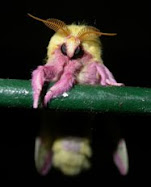
Io Moth
I know I haven’t been blogging lately but I have been busy catching up on labeling and organizing my photos. Specifically, I have been working with Curt Lehman and the website Butterflies and Moths of North America. He has confirmed my identifications and named photos when I was clueless. The records of what I have been seeing will be entered on the web site database. So far I think we are at around 300 species of moths.

Painted Lichen Moth (Hypoprepia fucosa)

We have been doing about 10 a day for at least a month now. I have photos of moths that have come to my porch light from 2004 through 2010. Last year I took photos every night that I was home when the weather cooperated.

Giant Leopard Moth  (Hypercompe scribonia )
After we figure out what they all are, I hope to contribute some of my photos to the web site but for now he is just entering a record of what was found in my county in West Virginia. It doesn’t seem like much but who knows, there could be one in the lot that extends the range for that species or showed up before it was supposed to.

Pyrausta bicoloralis

Besides I love to take photos of them and enjoy their subtle beauty

Horrid Zale (Zale horrida)

and sometimes no so subtle.

Ailanthus webworm moth (Atteva punctella)

Some are just plain strange.

Common Looper Moth (Autographa precationis)

Some don’t look like moths at all.

Yellow Collard Scape Moth (Cisseps fulvicollis)

It is a good project for anyone with a camera and I wish to encourage everyone to take photos and send them in to add to the records. It is good citizen science. The web site is: http://www.butterfliesandmoths.org/