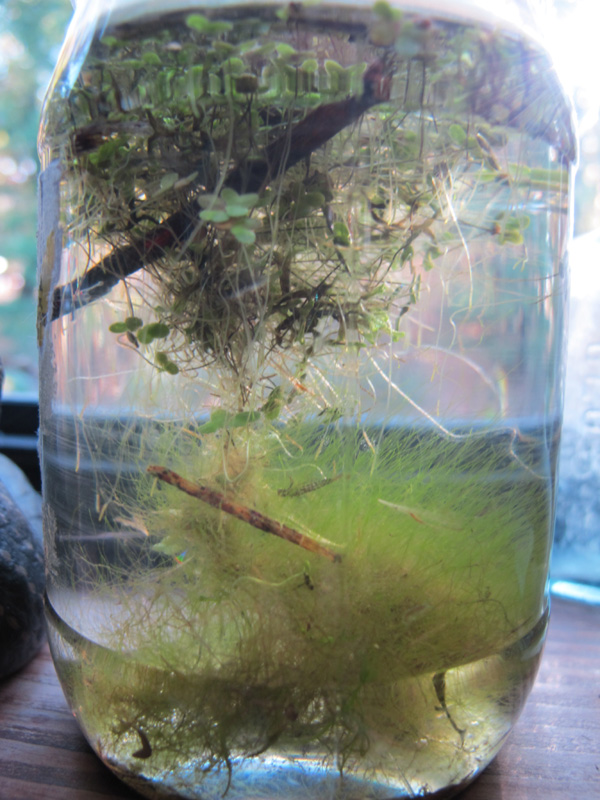
In order for my pond sample to be healthy I included some green stuff to provide oxygen. I had no idea what they were at the time but they were green so I figured, like vegetables on my plate, they are good to include.

Lemna minor (Lesser Duckweed)
The floating tiny Lilly pad looking plants are Duckweeds from the Lemnaceae family. They float on the surface of the water with a single root hanging down.
When I collected the water from Altona Marsh, my jar and hand was covered with them. I have seen them so thick on some ponds that you cannot see the water below. In situations like that they shut out the light and the plants below die along with the herbivorous insects that feed on them. Yet, they can also be a good tool for filtering and cleaning water. From what I read there is still a lot of research going to find ways to use them to clean up the environment.

I think what I have in my sample is Lemna minor (Lesser Duckweed). The common name Duckweed comes from observing ducks feeding on these tiny plants. They are high in protein, more than soybeans and are eaten by people in some cultures. Since they stick so well to my fingers I imagine that they stick well to ducks feet and are thus transported from pond to pond.
Another plant I think I have identified in the water is a Liverwort called Riccia fluitans. They grow just below the surface as you can see here. The branched thallus is darker green and thicker than the duckweed. They will also grow on damp soil and in that case, according to Ann Morgan (Field Book of Ponds and Steams), they can be reddish or purplish. Her book was written in 1930 so I wouldn’t swear by it but you can bet that the next time I go to Altona Marsh I will be looking.

Riccia fluitans
A third plant I have in the jar, I believe is a green alga species in the genus Chara called Chara vulgaris. What I’m talking about is the plant that has a defined stem and a whorl of leaf like structures along the stem as pictured below.

Chara vulgaris
There are lots of algae in the jar as well. The long stringy algae might be Zygnema species.

Zygnema species
Desmids are green algae cells that are often found in bogs similar to Altona Marsh where I found these. This crescent-shaped one is a Closterium.

Closterium
Below are some other shapes of algae that I found. Even though I don’t know what they are now I find them totally fascinating to look and loads of fun to find.


You can see some Diatoms in the photo above as well as algae.






+DSCN5800+for+blog.jpg)