Showing posts with label Odonata. Show all posts

Friday, April 5, 2013

Claremont Wilderness Park, California


The day was perfect and Cindy and I were on a bug safari in Claremont Wilderness Park when we spotted this Bee Fly.  I think it was a Conophorus fenestratus but perhaps it should have been called a “frustrateus” since it was so hard to identify. As you might recall Cindy is the creator of the blog BugSafari.
 
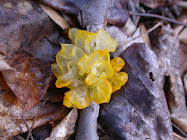
While looking for insects on dead logs I found a cup fungi. Don’t know what it is yet.  I wish I had more mushroom field guides with me, I only brought the small one.
 
On the log was one of my best finds of the day, a Liometopum occidentale (California velvety tree ant).  I had never seen an ant with marking like these but there were very hard to photograph.  They rushed about so much and eventually started biting me.  Cindy suggested we give them some water since we were in a dry area.  I wouldn’t have ever thought of that and it is something I will need to remember as I travel into more desert regions.  Well they just ignored that so she pulled out an energy bar and gave them something sweet.  I don’t think they ate any but they were curious and I was able to get this good photo of one checking it out. 
 
We stopped doing battle with the ants and continued on up the hill where I found a familiar fern, well it was not really familiar but it was a polypodium species and we have them in West Virginia.  This was a Polypodium califomicum (California Polypody).

 
One of the seepage area had a couple nice insects. First was Erynnis propertius (Propertius Duskywing).
 
And later a Ischnura denticollis (Black-fronted Forktail). Both were new to me.  At first we only caught a glimpse of the forktail but there are so territorial I knew it would come back later so we went on and sure enough it was there when we came back by.
On my big adventure I have been enthralled by lizards, even with the most common Western Fence Lizard. Isn’t it handsome and very cooperative?  There tendency is to freeze when spotted so they make good photo subjects, not even twitching. But then they dash off at lightning speed.

 
One of the most beautiful creatures we found was a Limenitis lorquini (Lorquin's Admiral).
 
Cindy has an uncanny ability to spot the tiniest insect on a leaf of grass and I was getting so frustrated and not finding much, even though I can spot insects equally as well.  Then I realized that I was not familiar with the leaves and grasses we were seeing so the odd insect on a leaf doesn’t pop out. She likened it to a proofreader who is so familiar with the shapes of words that when a word is misspelled it almost pops off the page.  So as we continued back to the car she casually says, “There is a red spider over there”.  Well….it WAS on her side, and like I said she has an eye for insect spotting. Was I jealous?  Sure wouldn't you be. She is a generous teacher and I really learned a lot from her on this outing.
Phidippus johnsoni (Red backed jumping sipder)
We sort of ended on a sad note when we found this baby rattler tossed to the side of the trail.  Besides being a walking trail it is also a bike trail and it looks like this one had the marks of a tire track across its’ body.  You can see it has one button, the start of a rattle.
 
It was belly up but so we turned it over for a better look.
 
We both touched it and it touched us as well.


Monday, March 18, 2013

Mojave Desert section of Joshua Tree National Park


There was no real boundary line between the Colorado and the Mojave Deserts, just a gradual change in elevation and new plants began to dominate the landscape as I drove on. Joshua Trees were  just everywhere and the place reminded me a little of Saguaro National Park except the dominate tree was Joshua instead of Saguaro.  There were also a lot of Mojave yuccas. Actually Joshua Trees aren’t trees at all but a species of yucca.  When they are small they look similar except Mojave yucca always had splinter-like threads on the edges of its spine-tipped leaves as seen below.

See how a Joshua Tree doesn’t have those. It has a cleaner look.  

I found one beginning to bloom.
 
 
Boulders also were everywhere in this part of the part and became the dominate feature. 
 
Split rock was the name of one of the picnic areas;
besides the split rock it also had a rock that reminded me of a Henry Moore sculpture.

As I was leaving that group of rocks a coyote crossed the road and I slammed on my breaks to take a photo.

Another popular rock was Skull Rock.

I was surprised to see a female Variegated Meadowhawk (Sympetrum corruptum) at one of the oasis.


Wednesday, January 19, 2011

Damselfly nymph in winter


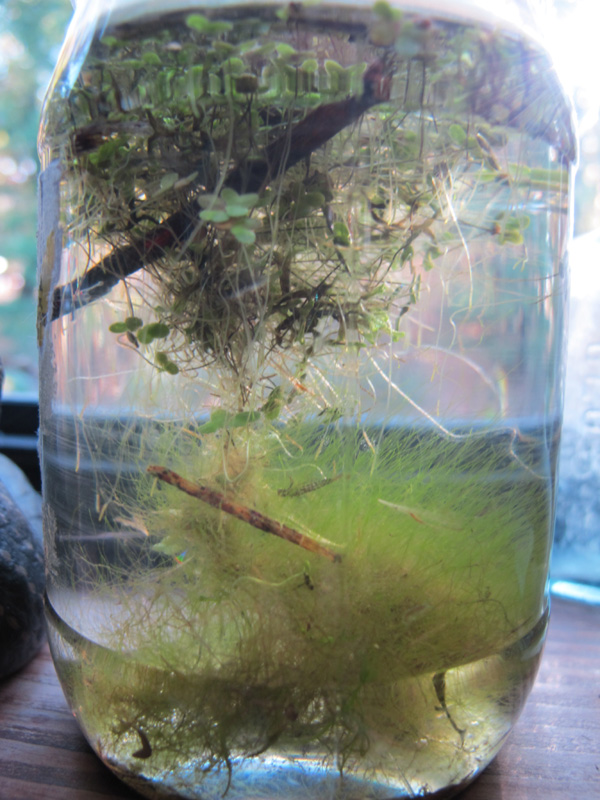
At the end of October I took a walk to Altona Marsh and collected some of the water along the track.


I just filled up two plastic peanut butter jars and made sure I had some duckweed, algae, sediment from the bottom and bits of other stuff. I didn’t really look to see what I had. With two jars I was sure to get something interesting.

Sure enough, after the water settled for a few hours I was able to see an Odonata nymph. The three leaf-shaped gills extending from the hind end of the body indicates that it is a damselfly. I haven’t a clue what species this is. They overwinter as nymphs and emerge in late spring. They are very predacious and eat every kind of aquatic insect, small crustaceans and snails so I think there will be plenty of food in this one jar for a while. I have actually seen a few things disappear since March and I suspect this is the culprit. Most of the time it just sits and waits for a victim to come by.

I soon realized that I was going to get distorted photos from the jar so I bought a small rectangular plastic tank which made it easier to get close up with my camera. Just recently I took the photo below. I think it must have molted because it is so clear and you can see the insides. Earlier it was emerald green. They molt between 6-15 times. With each instar the nymph get darker in color. Now you can clearly see the tracheal gills and tracheae and lines with the consequent flowing of the blood throughout. I think the darker part in the middle is its heart.


You might be able to make out the labium that looks like its chin. When it is ready to catch something the labium flies out with the swiftness of a frogs tongue and grabs it’s pray and snaps it back into its mouth. I watched it stick part of it out and place its front legs up as though it were cleaning the tip. I wasn't quick enought to get a photo but here is another view.


When I turned the container around it would bend its body to move the tail in my direction. I wonder if that was some sort of defense action. It did it several times.


They move about slowly by crawling or swaying like a fish by sweeping their tail from side to side. It has been really fun to watch especially as the snow falls.

Check out other blogs about water at Watery Wednesday.

Tuesday, August 17, 2010

Dragonfly birth

These are old photos that I would like to share because they tell a interesting story -- the photo story of the birth of a dragonfly.  Unfortunately I don't have the complete set of photos for one species so I have combined them to demonstrate this part of their life cycle. So how do they get from this creepy looking nymph that crawls around the pond, lake, stream floor eating everything it can catch ...


...to this beautiful dragonfly.


To begin with the nymph crawls out of the water and attaches itself to some sort of vegetation or hard surface. I have seen them on plants and on trees next to the waters edge. In fact I have even seen them on an old umbrella that was tossed into a small pond. They don't seem to be too picky. 


Below is a small series of photos I took of an Emerald emerging.


You can see that it first attached itself to what I thought was a plant but upon closer inspection realized that is was attached to a exoskeleton (exuviae) of a previously emerged dragonfly. Like I said they don't seem to be picky.  At this site there were hundreds of them emerging or had emerged earlier that morning.

The back of the exoskeleton cracks open and the adult form sort of pushes its way out and then hangs on while it pumps blood plasma into its wings to expand them, similar to a moth or butterfly.


This one is has its wings expanded and is letting them air dry and harden. They are most vulnerable at these early stages of their life. Those white string like things are spiracle tubes that the larva use to breath. They seem to be the last thing that is released as the adult emerges.


Below is one that has fluttered away from the exuvia and is hiding on the ground. At this stage, the teneral stage, you can see the wings are very shiny and soft.  They are still very easy to catch but can be difficult to identify because some of the colors and markings have not fully developed yet. In a few hours, once the wings have hardened, this one will be almost impossible to catch.  


Below are other views of exuvia.  With the right key you can figure out what species emerged or at least what genus.


In the photo below you can see it's jaw that extends out to catch prey. 

Below are some adult photos I have taken over a few years.

Cobra Clubtail - Gomphus vastus

Common Whitetail - Libellula lydia


Ebony Jewelwing

Yellow-legged Meadowhawk - Sympetrum vicinum

Variable Damselfly

Twelve Spotted Skimmer

See more watery places at Watery Wednesday.