Showing posts with label Fern. Show all posts

Friday, April 5, 2013

Claremont Wilderness Park, California


The day was perfect and Cindy and I were on a bug safari in Claremont Wilderness Park when we spotted this Bee Fly.  I think it was a Conophorus fenestratus but perhaps it should have been called a “frustrateus” since it was so hard to identify. As you might recall Cindy is the creator of the blog BugSafari.
 
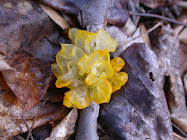
While looking for insects on dead logs I found a cup fungi. Don’t know what it is yet.  I wish I had more mushroom field guides with me, I only brought the small one.
 
On the log was one of my best finds of the day, a Liometopum occidentale (California velvety tree ant).  I had never seen an ant with marking like these but there were very hard to photograph.  They rushed about so much and eventually started biting me.  Cindy suggested we give them some water since we were in a dry area.  I wouldn’t have ever thought of that and it is something I will need to remember as I travel into more desert regions.  Well they just ignored that so she pulled out an energy bar and gave them something sweet.  I don’t think they ate any but they were curious and I was able to get this good photo of one checking it out. 
 
We stopped doing battle with the ants and continued on up the hill where I found a familiar fern, well it was not really familiar but it was a polypodium species and we have them in West Virginia.  This was a Polypodium califomicum (California Polypody).

 
One of the seepage area had a couple nice insects. First was Erynnis propertius (Propertius Duskywing).
 
And later a Ischnura denticollis (Black-fronted Forktail). Both were new to me.  At first we only caught a glimpse of the forktail but there are so territorial I knew it would come back later so we went on and sure enough it was there when we came back by.
On my big adventure I have been enthralled by lizards, even with the most common Western Fence Lizard. Isn’t it handsome and very cooperative?  There tendency is to freeze when spotted so they make good photo subjects, not even twitching. But then they dash off at lightning speed.

 
One of the most beautiful creatures we found was a Limenitis lorquini (Lorquin's Admiral).
 
Cindy has an uncanny ability to spot the tiniest insect on a leaf of grass and I was getting so frustrated and not finding much, even though I can spot insects equally as well.  Then I realized that I was not familiar with the leaves and grasses we were seeing so the odd insect on a leaf doesn’t pop out. She likened it to a proofreader who is so familiar with the shapes of words that when a word is misspelled it almost pops off the page.  So as we continued back to the car she casually says, “There is a red spider over there”.  Well….it WAS on her side, and like I said she has an eye for insect spotting. Was I jealous?  Sure wouldn't you be. She is a generous teacher and I really learned a lot from her on this outing.
Phidippus johnsoni (Red backed jumping sipder)
We sort of ended on a sad note when we found this baby rattler tossed to the side of the trail.  Besides being a walking trail it is also a bike trail and it looks like this one had the marks of a tire track across its’ body.  You can see it has one button, the start of a rattle.
 
It was belly up but so we turned it over for a better look.
 
We both touched it and it touched us as well.


Tuesday, June 12, 2012

Whites Run


One of the days during the WV Wildflower Pilgrimage at Blackwater Falls I took a trip with one of the leaders as he scouted out the area and planned his route. The day was a little drizzly but that certainly didn’t stop us.

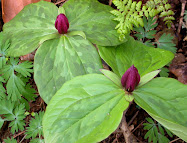
Many of the normal wild flowers had bloomed early but there were a few left such as this Painted Trillium (Trillium undulatum). It really only grown in cool, moist, humus-rich acid soils so it is very common in this part of WV unlike the dryer habitat where I live in the eastern panhandle. The seeds are dispersed by ants when they take them into their tunnel to feed on the nutritious structure called elaisomes that is attached to the surface. Notice how the flower has three petals, three sepals and is generally divided into threes.


Our route took us up Whites Run where the water was rushing down the because of the rain. The photo below was taken at the lower part of the stream and you can see how the water had accumulated more than in the previous photo that was taken more at the top of the mountain.


At the very top we were greeted with this beautiful pasture with the mountains in the background. There aren’t any in this photo but a lot of trucks were passing us on the road taking sheep and cattle up to these high pastures for the summer.


Here is a blow up of the barn below. Notice the speed limit sign.


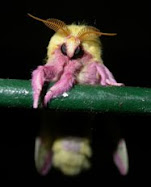
We made several stops and at one a Catocala ilia caterpillar was found. It feeds on oaks. The adult is an underwing moth.


One of the defining characteristics of this caterpillar is its pink under side.


I thought this Maidenhair Fern was especially pretty. Like the Painted Trillium this plant prefers moist humus rich soils.


Nearby was a snail but I have no idea what species.

This was a fun find in the one of the pull off areas. These are aften refered to as "benchmarks". These marks were often placed as part of triangulation surveys, measurement efforts that moved systematically across states or regions, establishing the angles and distances between various points. Such surveys laid the basis for map-making in the United States and across the world. This one has a triangle in the middle indicating that is a triangulation station marker or the main mark. I cannot honestly say I undersand how it all works but it does help in making the US.

Mostly I take close up photos but I really enjoyed these high back country scenes.


Tuesday, June 28, 2011

Panther WMA Brooks Bird Club Sortie

Brooks Bird Club of WV has a sortie each year for a week round about Memorial Day.  This year they went to Panther Wildlife Management Area in McDowell County.  This was an opportunity I jumped at because it is down in coal-county and it seemed best to go with a group who knew where to stay and where to visit.  The facilities were very nice at the park as you can see below. We stayed in the group camp building where we ate and made plans for each day.


One the side of the building I found these old Dobson fly egg cases.  They reminded me of the shell fossils I have found in the eastern panhandle. 


We spent mornings on 10 mile bird runs, afternoons and evening on breeding block bird surveys. The Brooks Bird Club is in the middle of a 5 year survey to revised the breeding bird atlas of WV. We also recorded reptiles, amphibians, butterflies, moths, dragonflies and bees that we saw. Another large part of the observation was spent on plants in an attempt to record at least everything we saw blooming. It was like a mini bio blitz. Here are the highlights for me, not in any particular order.


There was a stream along all of the roads with steep mountains in each side and with a little imagination I could believe that if I stood in the stream with my arms outstretched I would be able to touch each side. At one location there was room for only a one lane road yet the traffic went both ways. Below are views of one of the mosses that I found on the dripping outcrops.


Apple moss  (Bartramia pomiformis)

And liverwort
One evening back at the camp I found this Gray Petaltail dragonfly resting on the side of the tree. They are very docile and not easily frightened so I was able to get very close for the photo. 


A new butterfly for me was Northern Cloudywing – Thorybes pylades. This one I had to catch and then release after identification.


One evening went down the road and briefly stopped at an area where a beaver had made a nice pond. You can see the view of the dam from the road. It was about 4-5 feet high and made a nice place to look for dragonflies. 


A Tulip Tree Silk Moth flew in and I took this photo. It is a little blurry because it just wasn’t used to posing. Later another camper interested in insects and I returned to look for bees and dragonflies.


Fire Pink (Silene virginica) isin the Caryophilacea commonly called the pink family.  There are two recognized varieties of fire pink. Most plants of this species are classified as Silene virginica virginica var. virginica, however and endemic subspecies occuers in West Virginia called Silene virginica var. roobusta and I believe that is what I have here.


On the way back we found this Snapping Turtle on the side of the road.


The leaves were out and the undergrowth was abundant so actually seeing birds was difficult. Most were just heard and I learned a new way to describe the call of a Swanson’s Warbler: “Sweet, sweet, SISTERSVILLE”.  I will be sure to remember it because I grew up near Sistersville, WV.  They seemed to prefer the mountain laurels for hiding
.


Tiger Swallowtails were every where and at time I felt like I was about to trip over them.
The ten mile trips to identify birds began early each morning and for me they were a good way to see the country side before it woke up.  We stopped every half mile for a total of 20 stops and listened for 2 minutes.
One trip led us to a community that was raising roosters.  You can imagine what the sound was like with each cock sitting atop its home crowing with all its might getting ready for the fight that night.  Needless to say we didn’t stop in front of those houses to listen for birds, dogs were on guard and we just moved along, thank you.

Someone gave us the idea to drive up to the fire tower on the abandoned road. Of course we birded and botanized our way up from rut to rut.  We had only two trucks so some up had to ride in the back.


The American Toad (Bufo americanus) is a common species in this area. One of the fun things to see an American Toad do is eat. It closes its eyes when it swallows and will readily take a mean worm from your hand it you hold still and the worm wiggles.


 It was wonderful trip and I look forward to going on the sortie next year.


Be sure to visit Outdoor Wednesdays for other Outdoor adventures.

Wednesday, August 25, 2010

The second day of our collecting trip

The next day we met up with Kevin who drove us to his favorite places in Wood and Ritchie county.  We, or I should really say they botanized along the way.  I mostly took photos and listened in awe at their extensive knowledge of plants.  I am particularly interested in ferns so I was delighted when we stopped along the road to identify this Silvery Antherium.


Here is the underside.


Jane spotted this Sparassis (also known as cauliflower mushroom) from the car.
There were two of them and they really were the size of a cauliflower.


For me this plant was the coolest of the day. 
It is a Climbing Fern (Lygodium palmatum)  
and from what they said, in WV, it is only found in a few places.


The majority of the leaves are infertile and look like the palm of a hand.
The stems are very thin and tough.

Here are the fertile fronds.


We drove along the Little Kanawha River stopping to identify this
 Long Beaked Arrowhead (Sagittaria australis).

Along the way Kevin told us about the geology and natural history of the area. Jane grew up near by and told an interesting story about a town and how they made Mountain out of Mole Hill, WV. In  July of 1949 representatives of the Borden Milk Company approached the people at Mole Hill with a plan to help them get a paved road to their community if they would be a part of a publicity stunt. At the time Route 47 was described as a "narrow snake path" except for the short concrete section just outside of Pennsboro. They had the understanding that if they went along with the stunt and changed their name to Mountain as part of the Borden County Fair events, the governor and other politicians would come a they would soon get a new road.  Well like a lot of promises from industry and the government this one was not kept, yet the people at Mole Hill are now stuck with the name Mountain and to make matters worse there isn't even a mountain near by. According to some, the locals still call it Mole Hill and there isn't even a post office there any more. They did get the road...ten years later but that had nothing to do with the name change.  I guess when they say, "don't make a mountain out of a mole hill" it is good advice to follow.


Back at Kevin's I found this Tan Crab Spider (Xysticus transversatus) muching on an ant and

 
a Ray Spider (Theridiosoma gemmosum) egg case.

For more adventures in the ourdoors visit Outdoor Wednesdays.