Showing posts with label SSWMA. Show all posts

Wednesday, January 6, 2010

Snowy walk in the woods


My most recent trip to the Blue Ridge Tract was with Trillium after our big 2 foot snow. By then the rain had melted some of the snow but the ground was still covered in the forest. I always look for insects when I am out and this time I found about five tent caterpillar egg cases on one small cherry tree. Most of them had been eaten into but one was still intact. I brought it home to see them hatch out and study them up close. I didn’t think the tree would mind and I can feed them to the birds.


Down by the wetland area Trillium noticed a hundred or more spider threads floating on the dead stems. Close inspection revealed a very tiny spider at the end of one strand. After they hatch, baby spiders let out a string of silk that blows in the wind. When they are ready they let go of their hold and are pulled away with the flying silk. This is called ballooning. Personally I think it is very gutsy because they have no idea where they will land. She also spotted another spider in a foot print.


We found two interesting fungi. One, seen below, is a type of puff ball. It is called Calostoma lutescens and I have found them before. I was excited to see these puffballs in a new location.


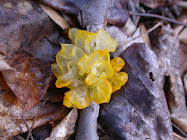
The other interesting fungi we found was a jelly fungi, called Auricularia auricula. The common name is Wood Ear or Tree Ear and according to Bill Roody in Mushrroms of West Virginia it is edible even raw and dries well for future consumption. It almost doesn’t look real but it is.


The thing that most excited us and occupied our attention was the animal tracks we could see in the snow. Deer and squirrel tracks were abundant. Here is a raccoon track showing those charastics toes they have.


The find of the day was Black Bear tracks. It was hard to believe but the size, shape and gait of the tracks didn’t lie. I knew black bears were up there but this was the first evidence I had personally seen.


We followed them up the fire road but didn’t peruse them into the woods. To me they looked old because our own tracks were going much deeper into the snow. I thought the bears would be snuggled up fast asleep by now but in our area they could still be found until January. You can bet this spring I will be looking for scat and other bear signs. Wanting to learn more about tracking I asked a fellow blogger who loves to track for good resources. Ellen Rathbone, replied with a very comprehensive blog on the subject. Be sure to visit her blog Adirondack Naturalist and check out her reply and other pages for examples.


You can also see Trillium’s thought on our walk at her blog simply called “Trillium”. There are signs of life in the woods everywhere and I can’t wait to get back out and look for more.


See more outdoor adventures at Outdoor Wednesdays.

Tuesday, December 15, 2009

Frozen Puddles


Walking along the fire road through the woods I begin to take notice of the frozen puddles and the patterns formed by the frozen ice. I was curious how those contour looking lines were formed. When I returned home I did some research and found that water freezes at 32 degrees. When the water gets colder the molecules slow down and stick to each other and form ice crystals. They also begin to move apart causing the ice to expand as much as 9%. I was also reminded that ice “feels cold” because it has lost energy as heat and that ice floats. The floating part is especially good news to fish and frogs in the water that might otherwise be crushed.


These are all things I learned in grade school but it is good to be reminded of the wonders of the universe every now and then. But I still didn’t find out how those circles came about. I have my own theories but not the facts.

I resolved that it is OK. I don’t need to know everything about ice to take pleasure in these sculpted frozen puddles. Besides it’s just plain fun to stomp on them and hear that “crack” as the ice breaks under your feet, to be a kid again. You might say I was cracking my way down the road. So go ahead, stomp on those frozen puddles, no one will notice that you are doing it deliberately... unless they see your smile.

See more at Watery Wednesday.

Vunerable—Yes, even a Multiflora Rose is vunerable

I found a Multiflora Rose while on my walk last weekend that looked strange yet beautiful. I knew it was a rose because of the shape of the leaves and the thorns and figured it was probably a multiflora because they are prolific in the forest of West Virginia. So I took this photo with the thought of learning more.


It looks like I altered the photo doesn’t it? But I didn’t.
The colors and the bunched up leaves were as I found them.


Once home I began searching through my books and internet and found an article by James W. Amrine, Jr. associate professor of entomology and Dale F. Hindal, professor of plant pathology, in the Division of Plant and Soil Sciences, College of Agriculture and Forestry, West Virginia University. It turns out that even the fast spreading, can’t kill it, can’t pull it up, invasive Multiflora Rose is vulnerable after all. A teeny tiny mite is responsible for bringing down this Goliath.

CHORUS: How small it is?

The mite is so small it only has room for two pairs of  legs on it’s tiny body instead of the usual four pairs.

CHORUS: (Repeat phrase)

It is so small that 20 mites can fit on a regular pin head.

But the mite just spreads the weapon, a virus called Rose Rosette Disease (RRD) also known as witches’ broom of rose, a condition fatal to the multiflora. The eriophyid mite, Phyllocoptes fructiphilus feeds on the rose thereby inoculating the plant with the RRD disease. Next a bright red to dark red pattern develops on the leaves. Thirty to 90 days later the infected rose produces lateral shoots that are bright red as seen in my photo. A large number of the shoots form the symptom known as witches brooming. These leaf clusters can act as a winter protection for the mites. The RRD spreads from the canes into the roots and then to the entire plant. The plant dies after one or two years. That’s the good news. The bad news it that it can sometimes attack cultivated roses in your yard.

So you see even a tough plant like the Multiflora Rose can be vulnerable.


Be sure to visit ABC Wednesday.

Monday, December 14, 2009

Winter Walk

Welcome to my world.

Walking along my favorite trail on Saturday I stopped to take a photo of the Christmas Fern (Polystichum acrostichoides) next to the last bit of snow. It just looked so pretty I couldn’t resist. I think they are called Christmas ferns because they stay green all year long and in the past were used as part of Christmas time greenery. It was the first fern that I learned the name of and still remember it to this day. You see the pinnae (little individual leaf like parts) have a lobe on the base that makes them look like a mitten, a Christmas mitten and that is how I remember.


The spores are produced on the small pinnae near the end of the fern frond and are called fertile pinnae. They are smaller than those at the base and once the spores are spread into the wind they shrivel up and turn brown but I don't see any here.

On down the trail I came to the tree with the three mushrooms growing on the side. Remember I wrote about it last month and thought you might like to see how they are progressing. You can see the original post HERE. They are melting away.


I went further up the trail than I have been going lately and ventured into the first meadow where I found some tracks in the snow. The snow was still pretty deep here and I was not able to figures out what made the tracks and I am just learning to recognize tracks.


This same meadow is surrounded by Virginia Pine (see previous blog) and I found a good example of cones showing one closed, one partly open and one fully open.


Back on the trail I went still further up to the larger meadow and found some Bittersweet (Celastru orbiculatus). I’m not sure where the name came from but it seems appropriate to me because the seeds look beautiful and are fun to collect for winter decoration on wreaths but after the season is over the seeds that dropped to the ground are near impossible to pick up and they begin to grow where you don’t want them. It is very invasive and best to leave in the woods. When it climbs up trees it can smother them and actually break some of the smaller trees from the weight of the Bittersweet fruit. I read that it was introduced in the 1860’s and often associated with old home sites. And it just so happened that I was in an old home site or what appeared to be one.


Close up of the Bittersweet.


You can see here where fencing from the old farm has become a part of this tree as the tree continued to grow. This is a common site on this land. At first it looked strange to see a fence coming out of the tree but now I am used to seeing it. Isn’t it wonderful how trees do their best to keep growing and not give into our neglect? I love to find evidence of these old homesteads.

I found the fence because I was off the trail taking a photo of this Running Ground Pine (Lycopodium clavatum). They are part of the Clubmoss family Lycopodiaceae.

The sky was starting to get an overcast so I headed back to the car. While I was in the parking lot a Red Shouldered Hawk flew over and landed on a nearby branch. It stayed while I tried to get a good photo and then flew off. I wonder if it was the one I saw this summer and shared a moment with. You can read about that one HERE. Saying goodbye to the hawk I drove on home after a wonderful day in the woods.


Sunday, December 13, 2009

Pine Cones

These Virginia Pine cones (Pinus virginiana) were found in a small meadow in the Blue Ridge Tract of Shannondale Springs WMA. I was up there this weekend for a walk before the weather gets too harsh. Here are a couple of pine cones from that trip. The left one had not fully opened up. The monochrome photos really bring out the sharp points along the cones.


The cones often stay on the tree for several years and sometimes don’t release their seeds until the second year.
Another name for Pinus virginiana is Scrub Pine or Jersey Pine. They grow well on poor, dry upland soil and are often used to reforest an area. I believe they were planted here for that purpose because I don’t see them throughout the area. They provide food for small mammals and birds as well as cover. You can click on the photo for larger views.

The needles are in pairs. I first learned to identify this conifer from the Naturalist at Cacapon State Park in WV. She said for our area you could remember that it was a Virginia Pine because when you held the base of the needle pair in your hand it formed a “V” for Virginia. But as I learned during my trip to Eastern Maryland this past summer you need to be careful because I found two leaf needles that are not Virginia Pine. The Loblolly Pines have two needles but they are much longer and not twisted like the Virginia variety.


The mature female cones are rather prickly as you can see from this photo taken in the same area in April earlier this year.


In the spring, its yellow male cones produce a lot of wind-blown pollen, to pollinate the female flowers or immature cones. This is what they looked like in April.


These needles had a blub like growth at the base. I suspect they are the beginnings of the male reproductive part but I am not certain. I haven't found anything about them yet but I am still searching.


I love these monochrome photos and you can see more at Monochrome Weekly by clicking here.

Wednesday, November 25, 2009

Slime Molds

In the previous blog I briefly mentioned finding slime molds on the cut log next to the trail and the mossy log with the Deadly Galarina. Here are some of the photos I took of those.


Slime molds are not a fungus, an animal, plant or bacteria but they are a new independent group of organism. There are around one thousand know species found worldwide. I think collectively the true slime molds are called myxomycetes and they are the ones I most often find since the cellular slime molds are only visible through a microscope.

This one is Metatrichia vesparia and I find it alot.


I'm not sure what this one is. The enlarged view is below.


As seen through the microscope.

I don’t even begin to understand them; nevertheless I love to look for slime molds. Currently our weather is wet and drizzly making it good for setting the stage for slime mold growth. Most of the times I find them on damp logs but they can be found on the ground, leaves and standing dead trees.

I found several on this log as well.


The spores are just about every where so it makes it relatively easy to grow them. Pull off a little piece of bark, soak it and then place onto a wet paper towel in a closed container and wait. Try several pieces for better results.


I find them interesting because they come in a variety of colors and structures that can be seen without a hand lens. Of course a lens shows more fascinating details.

I found this one and the following slime molds last year.


I think the common name for this one is Wolf's Milk.


Stemonitis splendens, Chocolate Tube Slime Mold


A biologist and mycologist friend told me you can feed them and watch them travel. The can go as fast as 1 millimeter per hour as they flow over and ingest their food. She was encouraging me to do so but I haven’t yet. Maybe that will be a good winter project.


Be sure to stop by ABC Wednesday for other interesting things.

Tuesday, November 24, 2009

Return trip

My walk in the woods on Saturday was almost a rerun of my October 31 hike. Again I went to the Blue Ridge Tract of Shannondale Springs WMA and stopped at most of the same places.


You can compare photos of the trail last month and now. Click on the photo for the link back.

You can see the sawed tree that I find so many interesting things like slime molds and flat little beetles. This is where I found the slug last month. Most of these are just under the bark. I can peel back a bit of it to explore the underside and then replace it when I leave. I have been lifting the same section for at least a year now.

Why keep going back? Well, I read somewhere that if you want to see something new keep going over the same route. It usually works. This time I think I saw a lot of the same things but different views and in different stages such as the oyster mushrooms. First is the October photo and next is the latest one. You can see how the mushrooms have opened up more. I will try to remember to take a photo next month and see how it has changed once more.


Just on down the hill is Furnace Run Wetlands. It flows into a drainage ditch that runs under the fire road and into Furnace Run. I found some interesting plants here. One is a River Alder (Alnus serrulata). They are native to the United States and grow about 8-12 feet tall. They have beautiful delicate cones smaller than the tips of my little finger. I wasn’t able to take a photo of the cones but I did find some catkins hanging over the water. River alders are resistant to most insects and disease pests. .

Alder catkins


I am not sure what the other one is. Any suggestions?

UPDATE: Woodswalker has suggested that this is a Branching Bur Reed (Sparganium angustifolium).  I hope she is correct because it is on the WV species of concern list.  I plan on getting back up there this weekend to get a more accurate description and fill out a lot of paper work to submit to the WV Deptartment of Natural Resources.


On up the hill I stopped at my favorite log with all the moss. Last month I found a little snail on cut the log but this one was on the moss log. These photos are a little better and show the pneumostome hole for breathing. I think this slug is rather cute. You can see the black dots of its eyes as it looks over its shoulder at me. The two antennas on the bottom are used for smelling and touch and don’t have eyes. I read that they can glide along a razor blade edge and not be cut but salt is deadly. I think salt may not be all that good for us either and I’ll definitely pass on the razor blade trick.


I found these mushrooms last time but this time I decided to tell you their name…“Deadly Galarina” (Galerina antumnalis). Another common name is “autumn skullcap”. As the name implies they are poisonous and should not be eaten…you will probably die. They are common in my region and found on rotting wood with moss. I recognize it by the small two-inch cinnamon-brown cap and the dark ring (annulus) on the thing stem (stipe). They sort of look like other brown mushrooms so be very careful if you collect and you should take spore prints for a more accurate identification and then don’t eat them. They mostly cluster in small groups but I have seen a lone one standing off from the pack as though it were being shunned for a bad deed. But I have never seen just one on a log.

At that point I turned around for home and left the mushrooms for the slug.

I will be enjoying Thanksgiving Holiday with friends; there is so much to be thankful for.

Visit more places at My World Tuesday.