Showing posts with label Caterpillar. Show all posts

Friday, May 4, 2012

Moths at the light

With the publication of the new Petersons Moth Field Guide I have been inspired to turn my porch light on again and photograph the critters that show up. I thought I had photos of just about every possibility since I had been doing this for several years but I was surprised to see a few new moths.
This one is a Schlaeger’s Fruitworm Moth (Antaeotricha schlaegeri) and its larvae feed on White Oaks so it was no real surprise since I have a very big White Oak in my yard. Since some moth mimic bird-dropping I think I should start investigating bird poop when I see it on tree limbs. In the past it has been something I have pretty much ignored but I can see now it has possibilities for finding other moths with similar habits. I knew about some of caterpillars that used that strategy but I didn’t realize that moths used it as well. So I guess the lesson is if you look like shit then just tell your friends it’s your strategy for blending in and not getting eaten alive.


This next moth was frantically flying and wouldn’t stand still for anything but I did manage to get a blurry photo. In flight it looked bright red but once I looked at the photo I could see variation and some pattern. I submitted it to BAMONA (Butterflies and Moths of North America) and it was identified as Pyrrhia expimens (Purple-Lined Sallow).


Here is another one I caught almost in flight as it landed on the screen door. It is a Bilobed Looper (Megalographa biloba), in the family Noctuidae.

Actias luna (Luna Moth) is always a welcome sight at my porch light. The tail on this one looked a little shorter than some that have visited in the past. Speaking of Luna and moon things The moon will be closest to the earth Saturday, and it will be a full moon, so it should be much brighter than usual. It is a supermoon.

Another large moth that showed up was Virginia Creeper Sphnix Moth (Darapsa myron) Most sphnix moths don't come to lights but I have seen this species on my porch before. The best way to see sphnix moths is to set out a moth bait. This year I am trying a combination of bannana and apples. First I freeze the fruit and then when it defrosts in a closed container it ferments. So far I haven't had any takers.

It was getting late in the evening so I decided to turn the light out but I had to have one last look to satisfy my moth addiction. And lo and behold there was a HUGH spider on the wall. Now I’ve seen these Wolf Spiders before but I have to say they can catch me off guard. This was obviously a female with egg sac in tow. Look closely at the sac to see how it is seamed together and how it is attached to the spinnerets. Wolf spiders are very protective their young. Once these eggs have hatched the young spiderlings will attach themselves to the fine hairs on the mothers abdomen and ride around until they are able to fend for themselves. The hairs are just barely visible in this photo.

I just never know what is going to show up.


Wednesday, October 19, 2011

Shenandoah River Walk

I love to walk along the Shenandoah River this time of year. The leaves and reflection in the water are stunning.


Of course I am still looking for spiders and I found this one from the genus Tetragnatha. There are 25 species in North America to choose from I think this one is Tetragnatha straminea. Also notice how long the legs are; they are about ten times the length of the carapace.


It is a long-jawed orb weaver and you can see the large chelicerae in this photo. They have long, slender abdomens as well. They make orb webs but I didn’t see its web. They catch prey using the web in the traditional sense but they also capture flies and other insects without the aid of a web.


They often can be seen stretched out on a twig or leaf and are almost impossible to see. The egg sac is a tightly woven sac sparsely covered with threads of beadlike, greenish silk attached to twigs and other objects. I looked but didn’t see anything like this nearby.


The walk along the river was really nice. Spice bushes are always good places to search for insects and it smell so nice as I turn over leaves.


To my surprise I found this fun looking colorful caterpillar out in the open. It is a Spicebush caterpillar (Papilio troilus) pretending to look like a snake. I think Disney should make a movie about caterpillars. This one could be one of the main characters. When it is in the early stages of growth it looks like bird poop so there could be a lot of fun teasing about that in the movie.


I have this whole cast of caterpillar characters in my head and maybe later this winter I will do a blog featuring them. For now I just want to show this one.


Here is a photo of two adults taken at an earlier time.


When I turned around to go back to my car I spotted a Praying Mantis eating a couple of bees.

Hello, do you want to join me? I have two bees.

They are very yummy.


 Most of the flowers were gone and I didn’t see any mushrooms but these three insects were great finds on such a beautiful day.


Friday, October 7, 2011

Caterpillars – Common Pug and Snowberry Clearwing

Spiders aren’t the only thing I have been seeing lately. When I found the Garden Spider Egg case I also found two interesting caterpillars nearby. The first one is a Hermaris diffinis, commonly called Snowberry Clearwing moth.

 Hermaris diffinis larva

Snowberry Clearwing moth adult

This is the less common brown form and I found it where I had seen adults earlier this year. It likes fields, woodland and forest edges. This one was on a fence row next to a field for cattle.

Hermaris diffinis larva


Isn't that horn at the end interesting? I suspect some of it's enemies are taken aback when they see this. I suppose I would be too if I sat down next to someone on the subway with a large horn.

The other one I found was a Eupithecia miserulata known as a Common Pug. The moth is really not much to look at and hard to identify from other Pugs but this caterpillar is pretty darn cool.

This is the adult Pug found at my porch light in early March.

Wagner in his book Caterpillars of Eastern North America says, “It’s coloration frequently blends with that of its foodplant --how the caterpillars come to match their background in coloration is deserving of study”. Is that amazing or what! It took me a while to find it in the book because mine was a bright yellow to match the yellow flower. Finally I just focused on the herringbone pattern and found it. The one in the book is brown.

Eupithecia miserulata larva (Common Pug)

You can see how it has been eating the petals of the flower.


Eupithecia miserulata larva (Common Pug)

When it was first spotted it was near the center of the flower and blended in but as I began to take photos it moved out and eventually took the position of standing up straight and stiff. I guess this normally works to ward off preditors but for me I was gratefull that it finally stood still so I could get a good photo.

Sunday, September 26, 2010

Looking Under Leaves

Looking under leaves can really be rewarding especially this time of year because many insects have laid eggs or are in their final development stage before the winter cold arrives.  Typically I like to walk along a trail that has over hanging tree limbs so I can just look up and see what is going on. The other method is to walk along the edge of a trail looking for signs of activity such as chewed leaf edges, folded leaves, dark spots on leaves, holes and really just about any leaf that looks odd.  The stems also need to be searched as well, you never know what may be hanging on or trying to blend in.  The one thing I need to be careful of is spider webs because when I am intently looking at leaves I tend to see right through the webs and accidentally reach right through them, messing up a good hours work for that spider.


One of my best recent finds were these three potter wasps nests that were on a branch hanging over the center of the trail.  I couldn't believe my luck. 


Potter Wasp of the species Eumenes built these to lay its eggs in the empty cell before providing it with beetle larvae to feed on as is grows. Wikipedia said that it is believed that Native Americans based their pottery designs upon the form of local potter wasp nests.


When I opened up this leaf roll I found this baby Spicebush Swallowtail caterpillar (Papilio troilus) still in the bird poop disguise stage. I was actually surprise to see it here since I really though they hung out on branches with the hope that their poop look would keep them safe.  I closed it back and it was none the worse for my quick peek.  You can see the final stage just before it becomes a chrylsis at the end of my previous blog August 31, 2010. Notice the web base that it laid down. When this webbing dries it pulls the sides of leaf together to make the fold. Because silk is strong and very felxiable I am able to slowly open it up without too much damage. When I let it go the leaf closes right back up.


Under this leaf I found a row of eggs that looked similar to to the stink bug eggs I found last week but these were in one row instead of a cluster.  Like those before, they had hatched out already.


I really lucked out when I found this White Furcula caterpillar (Furcula borealis) because it blends in so well. One thing I have discovered is that if you look at enough leaves then anything slightly different will stand out.  Movement helps to find birds but in the insect world you want to also look for something slightly different.  For instance you can see in the photo below that on the left there is a leaf and on the right the caterpillar is hanging. The leaf has edges but the caterpillar is rounded causing it to look slightly different, plus it is also hanging more vertical than the leaves.  These aren't rules but examples of just how a slight difference can be a clue and worth investigating.


The tail on this caterpillar was interesting. It was clearly trying to look like a stem, yet when I approached it with my camera the two parts split apart and began waving to scare me away.  My camera wasn't afraid and I was getting a good show.  Later I read that the hind prolegs are modified into these slinder paired stemapoda which can extrude bright filaments which release a volatile chemical. I think they react to sound and my camera was fairly quiet so I didn't get the full wrath.


July 6th I took a photo of this White Furcula moth at my porch light (see below). The gold specks are caused by reflective color and not mentioned in the guides that I have at home. 

Now look at the two side by side and you can see how the pattern in the caterpillar is the same as in the moth. You need to imagine that the moth is turned upside down and it might be easier to see.  The dark scales on the head, middle and end are in the same pattern as the dark areas on the back of the caterpillar. Pretty interesting.

Now back to other critters on the leaves.


Here is a spider hiding in a silk nest but I am not sure what it is doing.  When I held it up I could see its shadow holding still. You can see that it has at least one opening at the end.


Parancistrocerus bicornis or Eumeninae sp. wasp, I'm not sure which one it is but it was fun to observe it's behavior.  Sometimes insect behavior other than sipping nectar is hard to find, at least it is for me.  When I see them on nature movies they always seem to be cleaning themselves, fighting or laying eggs but I feel it is a really good day if I see any of that.  I tend to snap the photo and move on as if I had a urgent deadline to meet, when in fact I am really here to observe. My tendency to name, take the photo and move on is very strong. After it left, I looked at that spot and didn't see a thing that looked different.  At first I thought it might be laying an egg but that really didn't make sense to me. Then I read that some of them get parasitic worms and they wiggle in the dirt to get the worm out. In truth I have no idea what is going on here but it was wiggling its butt in the dirt for a while.

I found this large Green June Beetle (Cotinis nitida) because I caught it's movement out of the corner of my eye.  It is a member of the family Scarabaeidae and in the subfamily of flower scarabs called Cetoniinae.  When I was a kid my friends and I would tie a thread to the end of one of their legs and hang on as it flew around us.  Of course now I think that is cruel but we were scientist of sorts and were learning and becoming familiar with our environment.   We always let them go or they escaped leaving us with a leg attached to a thread.  Our relationship with insects always places me in a dilema trying to decide just what is the right thing to do.  Kill the pests, collect them for science, experiment with them to learn more or just watch.  Currently I am approaching each one as an individual. For instance I observed this one yet I kill the Marmorated Stink bugs that are invading my house as I write.  I don't like pesticides but I do practice integrated pest management and pick off individual insects that are eating my tomatoes. I also grow parsley and milkweed for butterflies and have collected moths and dragonflies for scientific studies.  I do know one thing thought...the more I learn about a species of insects the more likely I am to observe a behavior and try to protect and appreciate it's life.

This chewed off edge is what caused me to look on this leaf. What I found didn't do the chewing but rather it is hunting insects for its next meal.  It is a red lady beetle (Cycloneda munda) in the genus Cycloneda. They look like they have giant eyes and I suspect that they taste bad like most lady beetles.  I have never eaten one but I have held some in my hands and then tasted them on my fingers afterwards and they are pretty yucky. I should have been warned by the bright color but I am human and like a lot of us I didn't take heed...a bird has more sense.


All of these tiny speckled spots can only mean one thing.  My friend who is an expert in lace bug damage taught me how to recognise this sign. Turning the leaf over I found them.


On the left are the young and on the right is the mother on watch and ready to herd them to safety if threatened.  They are so tiny that this was about as good of a close up I could get. They are Hemiptera in the family Tingidae and there are more than 150 species in North America.  From what Laura told me they are host specific. The tiny dots are fecal matter. If you ever get the chance to see one through a hand lens you will be amazed at their structure.


This Northern Bush Katydid (Scudderia septenrionaalis) stood out because it just wasn't the right shape. The color is right but the shape isn't.  I think that if it had landed in another location it might have blended in better because this wings certainly do have a leaf shape.


This little Gray Hairstreak (Satyrium calanus) was nectering on one of the remaining blooming flowers I saw that day.  I can never resist photographing a butterfly even if I have hundreds already. 


Cardinal Flowr was the other blooming flower that I found down by the swamp area where I turned around to walk back up the hill to my car. I had lots of good photos in my camera and sights to share.

LOOK FOR OTHER CAMERA CRITTERS HERE.

Tuesday, August 31, 2010

A new find on the Blue Ridge Tract trail

I took this hike during the latter part of August and even thought a bit of time has passed I still wanted to share what I saw because one of the species was new to me and I thought interesting.  My walk started like any other as I went down the fire road headed toward the wetland area.


I saw several Zabulon Skippers (Poanes zabulon).


Zabulon Skipper, Poanes zabulon


I also found this Red Spotted Purple butterfly (Limenitis arthemis) that looked fresh like it had just emerged.


There weren't too many dragonflies around but I did manage to take a photo of this Common Whitetail ( Libellula lydia).


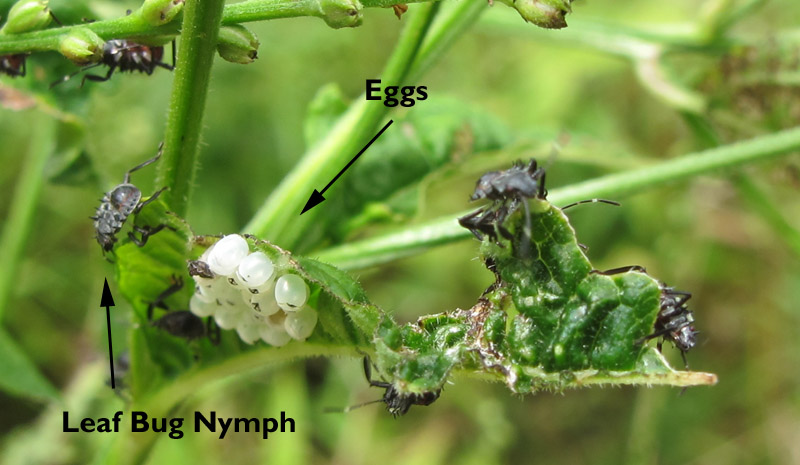
On one of the plants by the stream I found these eggs with tiny nymphs crawling about.


The egg cases were interesting. Notice that black outline of two triangles side by side, surely that is a diagnostic characteristic.  They looked like little leaf footed bugs from the way their legs were shaped even at this young age and I labeled the photo as such but I have since changed my mind and decided they are Brown Marmorated Stink bugs (Halyomorpha halys) like the ones that have been invading our homes these last couple of winters. It in an invasive insect and first reported in Allentown, Pennsylvania in 2001 and now it has spread to surrounding states.


As I walked on up the hill I began to look for leaf rolls to open up. Inside this one I found a Green Stink Bug (Acrostemum hilare).  I sure didn't expect that.


Hummmm...what is in this one? There is really a lot of leaf damage. I work in the city and I never see damage like this on the leaves but out here in the wilds of West Virginia the trees are full of holes and evidence of insects feeding.


I try to open these slowly and carefully so I don't disturb the critter too much. At first I just peaked into the end to see what was there.  Look at the antenna on this critter, they are folded back on themselves. Looks like this is the rear end.  Then it rattled in the leaf roll almost causing me to let go.


Since that strategy didn't scare me away it turned around to take a peak.  Ah ha! I've seen this before.


The night before I found one of these at my porch light when I was taking photos of moths. I hadn't really given it much thought until I found it rolled up in this leaf except for the fact that it had really really long antennae which is about five times the length of its body. It is a Leaf rolling Cricket (Camptonotus carolinensis). They form a flap which is folded over and pulled down with its legs and then from silk glands in its mouth it seals the edges shut.  They hide here during the day and come out to feed at night.  The females crickets have ovipositors that are upturned over it's back. They are wingless or to use a fancy word they are apterous.  They are also the only species of Gryllacrididae (raspy crickets) found in the U.S. So that was my new insect, not particularly pretty but certainly interesting.


Above is the one on my deck. I read that it likes to eat aphids at night but it might have trouble getting past this ant on guard at a nearby burr.


Just as I turned off the road onto the Jimmy Vardis trail I spotted two evergreen bag worms on two different trees. This one let me take a photo before it sunk back in and closed the top tightly. It was almost the size of my thumb. I went back later and they were completely gone. 


Fork-tailed Bush katydid (Scudderia furcata) hiding in plain sight.


This Spicebush Caterpillar was probably the find of the day.  I just happened to notice it on a low plant on my way back to the car.  It had probably crawled from the spice bush on the other side of the trail to this plant and was now in the process of turning into a chrysalis. 


Here is a top view where you can see those large fake eyes it is known for.  Below you can see it's round little head and the sling (see arrow) it has made to secure itself to the stem.  I stayed and watched for a while but nothing was happening except that my stomach was growling, so I left it in peace after taking a dozen or more photos.

Enjoy more outdoor adventures at Camera Critters.