Showing posts with label Amphibian. Show all posts

Wednesday, April 3, 2013

Slender Salamander


Recently I met the creator of Bugsafari and she has shown me some interesting creatures in Southern California.  Before driving to the tide pools in my last blog she lifted up her garbage can and showed me her resident California Slender Salamander (Batrachoseps attenuatus).   Like many of the salamanders in my home state of West Virginia this one is in the Plethodontidae family of lungless salamanders.  Mostly they are found more north of here but there are records for Orange County.
 
Slender salamanders are noted for having only four toes on their hind feet.


Its face has an alien quality about it, perhaps it is related to the star of the movie Paul, it does live near Hollywood after all. 


Wednesday, March 14, 2012

Cacapon State Park and surrounding hills

Last weekend was just one of those times that makes my soul jump with joy, the air was clear, a tiny bit crisp like we get in early spring and it just felt great to be outside without a inch and a half layer of additional clothing. I can see why spring is the time for mating when you finally have freedom of movement.


Up at, what I have named the Newt pond, I check for spotted salamanders and found l clumps of eggs wrapped around submerged twigs like insulation on the pipes in my house and the sperm pack ready to be picked up by females. The little blobs sit atop submerged leaves like little white gelatinous pyramids. Clearly there is extra sperm ready waiting.


At the end of the pond there were large masses of wood frog eggs finding safety in numbers. It is a strategy that hopes to keep the eggs moist. There was one clump on the edge and from experience I knew it would dry out before they had a chance to hatch so I picked it up and realized that it was covered with a layer of ice. Turning it over I had a good look at the individual eggs.


I thought I would look under some of the bark laying on the ground to see if I could find a spotted salamander hanging out before it descends deeper into the earth. They are a part of a group called mole salamanders, a name well deserved. I didn't see a salamander but I did find a centipede curled up. This one is from the order Geophilomorpha, common in rotting logs and the soil. It is very long and at first I thought it was two curled up. Generally they give me the willies but this one didn't move so I had the self composure to take this photo.


There were lots of clumps of this small white cushion moss in the Leucobryum family. The outer layers of the cells are dead and no chlorophyll which creates the white look. My hand is often pulled toward them to caress or pat them on the head.


Since I was so close to Cacapon State Park I decided to drive on over to visit the naturalist there and see what was new.  At the upper lake I found a couple of Canada geese and several red spotted newts. 

The newts were just hanging out but from the enlarged hind legs I could tell they were getting ready to mate.


I love their ability to wiggle through the water or walk on the bottom.


On the narrow trail that skirts the lake I almost stepped on the rather large puff ball.


Dicranum fulvum (Boulder Fork-moss)
I have never seen as much Candelaria concolor (candle flame) lichen as I found covering this branch. I had read that it was pretty common in West Virginia and like anything else the more you learn about it the more you see.
Candelaria concolor (candle flame lichen)

Tuesday, June 28, 2011

Panther WMA Brooks Bird Club Sortie

Brooks Bird Club of WV has a sortie each year for a week round about Memorial Day.  This year they went to Panther Wildlife Management Area in McDowell County.  This was an opportunity I jumped at because it is down in coal-county and it seemed best to go with a group who knew where to stay and where to visit.  The facilities were very nice at the park as you can see below. We stayed in the group camp building where we ate and made plans for each day.


One the side of the building I found these old Dobson fly egg cases.  They reminded me of the shell fossils I have found in the eastern panhandle. 


We spent mornings on 10 mile bird runs, afternoons and evening on breeding block bird surveys. The Brooks Bird Club is in the middle of a 5 year survey to revised the breeding bird atlas of WV. We also recorded reptiles, amphibians, butterflies, moths, dragonflies and bees that we saw. Another large part of the observation was spent on plants in an attempt to record at least everything we saw blooming. It was like a mini bio blitz. Here are the highlights for me, not in any particular order.


There was a stream along all of the roads with steep mountains in each side and with a little imagination I could believe that if I stood in the stream with my arms outstretched I would be able to touch each side. At one location there was room for only a one lane road yet the traffic went both ways. Below are views of one of the mosses that I found on the dripping outcrops.


Apple moss  (Bartramia pomiformis)

And liverwort
One evening back at the camp I found this Gray Petaltail dragonfly resting on the side of the tree. They are very docile and not easily frightened so I was able to get very close for the photo. 


A new butterfly for me was Northern Cloudywing – Thorybes pylades. This one I had to catch and then release after identification.


One evening went down the road and briefly stopped at an area where a beaver had made a nice pond. You can see the view of the dam from the road. It was about 4-5 feet high and made a nice place to look for dragonflies. 


A Tulip Tree Silk Moth flew in and I took this photo. It is a little blurry because it just wasn’t used to posing. Later another camper interested in insects and I returned to look for bees and dragonflies.


Fire Pink (Silene virginica) isin the Caryophilacea commonly called the pink family.  There are two recognized varieties of fire pink. Most plants of this species are classified as Silene virginica virginica var. virginica, however and endemic subspecies occuers in West Virginia called Silene virginica var. roobusta and I believe that is what I have here.


On the way back we found this Snapping Turtle on the side of the road.


The leaves were out and the undergrowth was abundant so actually seeing birds was difficult. Most were just heard and I learned a new way to describe the call of a Swanson’s Warbler: “Sweet, sweet, SISTERSVILLE”.  I will be sure to remember it because I grew up near Sistersville, WV.  They seemed to prefer the mountain laurels for hiding
.


Tiger Swallowtails were every where and at time I felt like I was about to trip over them.
The ten mile trips to identify birds began early each morning and for me they were a good way to see the country side before it woke up.  We stopped every half mile for a total of 20 stops and listened for 2 minutes.
One trip led us to a community that was raising roosters.  You can imagine what the sound was like with each cock sitting atop its home crowing with all its might getting ready for the fight that night.  Needless to say we didn’t stop in front of those houses to listen for birds, dogs were on guard and we just moved along, thank you.

Someone gave us the idea to drive up to the fire tower on the abandoned road. Of course we birded and botanized our way up from rut to rut.  We had only two trucks so some up had to ride in the back.


The American Toad (Bufo americanus) is a common species in this area. One of the fun things to see an American Toad do is eat. It closes its eyes when it swallows and will readily take a mean worm from your hand it you hold still and the worm wiggles.


 It was wonderful trip and I look forward to going on the sortie next year.


Be sure to visit Outdoor Wednesdays for other Outdoor adventures.

Saturday, August 21, 2010

Collecting trip to Western West Virginia

The first week of August my friend, Jane and I took a trip to Ritchie, Wood and Pleasants counties to collect bees and insects.  We also did a little botanizing along the way. Jane was collecting bees for a study she was helping with and I was collecting moths for a study I was helping with. We made the perfect pair except I collected at night and she collected during the day. Here are some of the highlight of our 3 day trip.

We stopped at a rest stop in Harrison County so of course we had to collect. I found this silver spider caught up in my sweep net. I'm not collecting spiders but I love to take their photos.


I also found a Tread-legged Bug like the one I had found last week at SCWMA but I managed to get a better photo of this one.

Thread-legged Bug.  It definitely has its eye on me. 

Most every where we went we found Eastern Tiger Swallowtails and Silvery Checkerspots.

Pearl Crescent or Silvery Checkerspot?
In Ritchie County we stopped at Tracy Lake where I found several Clearwing Hummingbird Moths feeding on the Bergamont.


Searching on the underside of the leaves I found...

a Hickory Tussock Moth Caterpillar (Lophocampa caryae).

While we were a man with scraggly hair and a grizzled beard drove up and stopped to talk. He was sweaty because he had been out cutting multi flora rose and was at the lake to take a bath. We got the impression that he hadn't talked to anyone for weeks because he almost talked our ears off.  He said he was from NJ and someone asked him to take care of their property in exchange for a place to live. They told him the place had running water, electric and free gas, which is common in WV.   It turned out that he had running water in the creek next to the cabin, had electric when the lightening struck and had gas when he ate beans for dinner.  He was quite a character and we soon left so he could wash up in the lake.

That night we went back to collect moths at my light sheet. 

It is hard to take photos on the sheet because it moves so easily but on the way out a tree frog jumped down onto the hood of the car.  A nice treat for the end of a long day.

Gray tree frog.

Enjoy other fine photos of critters at Camera Critters blogsite.

Wednesday, August 18, 2010

Afternoon with insects

A few weeks ago I took a trip up to Sleepy Creek Wildlife Management Area just to see what I could discover.  After the Nature Leadership Training course I have been very aware of insects so it is no surprise I found lots of them. But I was surprised to see the variety and a couple of new ones for me.

On the road leading to the lake I made a couple of stops to take photos of the butterflies. This year we seem to have an abundance of Eastern Tiger Swallowtails and I never tire of looking at them.

Eastern Tiger Swallowtail --Papilio glaucus

Silver-Spotted Skipper (Epargyreus clarus) is the largest skipper in my area. Here it is nectaring on thistle.

I saw a few of these metallic colored Dogbane Beetles (Chrysochus auratus). They look even shinier than in this photo.

Here is a member of the Diptera family, a Bee fly.  It was mimicking a bee but I wasn't fooled.


That bright orange insect is a day flying moth.  It also flies at night and often comes to my porch light. It is an Ailanthus Webworm moth (Atteva punctella).  The larval form feeds on Ailanthus (Tree of Heaven).


This cove on Sleepy Creek Lake is one of my favorite spots.  I have even seen beaver here and countless numbers of dragonflies. Today I found a couple of new insects.

Hummmm....what is inside this leaf roll?

When I opened it up this walking stick like insect quickly crawled out. Eventually it settled down and aligned itself with the mid-vein of this leaf  thinking it was hidden from view. I didn't get a good photo but it actually laid down on the vein and drew its legs to its sides and pointed the antenna forward. I probably wouldn't have noticed it if I didn't see it crawling around first.  This is an assassin bug in subfamily Emesinae of the Reduviidae family. The common name is Thread Legged Bug. 


Aphids but something is missing...ants.  I don't recall ever seeing aphids without ants nearby.  Ants guard aphids and in turn sip the honey dew that they excrete.  Below is a close up that I took through my hand lens and you can see the tiny drops just waiting to be harvested.  I wonder what happened to the ant colony.


I just finished reading E.O. Wilson's novel Anthill and I wondered if the ants that usually farm these aphids were taken over by a super colony as described in his account of the demise of the Trailhead colony.  Without ants taking the honey dew I am curious to know what will happen to these aphids and all that liquid at the end of their butts.

 
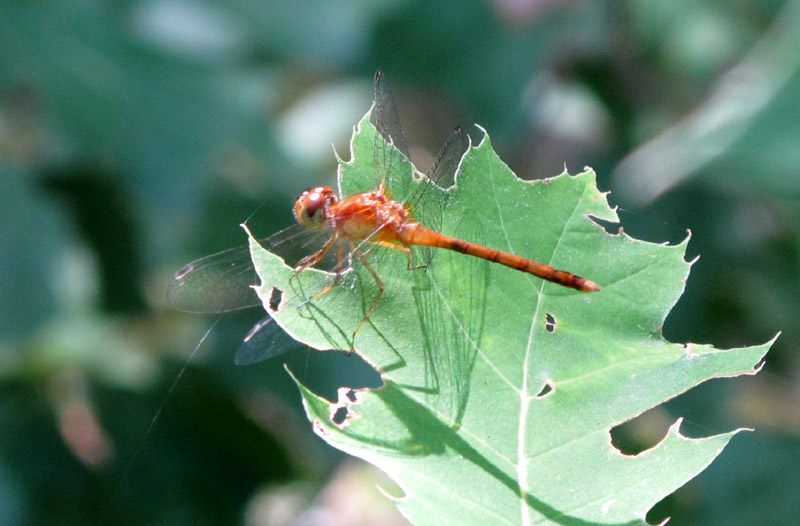
Dragonflies were all about. This one is a Yellow-legged Meadowhawk - Sympetrum vicinum.


Another rolled up leaf brought this spider to my attention. 


It is a Paraphidippus aurantius female spider and the very bright orange and metallic green is caused by iridescent scales. They are not very common and usually found in folded leaves like this one.  I chased it all around the the leaf trying to get a photo and it did not drop down to the ground like most spiders do. I suspect this one had eggs inside the leaf that it was guarding.  I also think it was eating.


This little critter crossed my path as I was leaving the banks of the lake.  It is a Spring Peeper and was blending in very nicely.  If I hadn't seen it hop I would never have found it. I can't even imagine all of the critters that was watching me that I wasn't even aware of.

See more nature at Outdoor Wednesdays.


Monday, July 19, 2010

Salamanders, Snails and Smooth Rock Tripe at Coopers Rock

After we left Cransville Swamp area we drove over to Coopers Rock State Forest to look for salamanders. I have been there at night but never during the day. We didn't expect to find much but since we were in the area why not take a look. 


Right off the bat we found this little Red Spotted Newt (Notophthalmus viridescens) out of the water. He looked like had just finished the red eft phase and was now heading back to his birthplace to breed and live out the remainder of his days. He was still tiny. Well that was unusual to see one in that stage of growth but when we saw three more walking about and crossing our path we began to count our blessings The very heavy rain we had driven through might have had something to do with them being out and about but it was unusual to see them in this stage of their growth while still on land.

We headed for the popular rock outcrops to see the Green Salamander (Aneides aeneus), not expecting to find any because they are typically only seen at night if you are lucky. And then you need to take a flash light and look deep into the rock crevices to find them. On a good night one is a great find. So imagine our surprise when once again the graduate student found this one, on a tree no less! In the day time, well OK, but on a tree...no way! We all concluded that this was probably a rare record of of a green salamander climbing on a tree. To our knowledge they had only rarely been documented on trees. It looked like the tail of this one was regenerating.


One of the other Master Naturalists lifted up a large rock and found this Northern Slimy Salamander (Plethodon glutinosus). We set it in the net so we wouldn't be handling it very much and could get a good view. Our hands can be toxic to salamanders especially since we had bug spray on us. They are fairly common in West Virginia but always a treat to see.

Here is a beautiful land snail that I found climbing on these moss and lichen covered trees. 

This is one of the many Smooth Rock Tripe covered boulders that we were looking into to find the green salamanders. So that concluded my stay at the Mountain Nature Camp in Terra Alta.

Go to other places with Outdoor Wednesday.