Showing posts with label Spider. Show all posts

Monday, July 16, 2012

Orchard Orbweaver and other spiderlings

The middle of last month I took a walk and found a couple of interesting spiders, well actually one species called an Orchard Orbweaver (Leucauge venusta). They are long-jawed orb weavers and their webs are horizontal or almost horizontal to the ground.


It was difficult to get under the webs and take the top side of the spider since they hang down from the center but you can see the spinnerets at the back of its abdomen. Since that day I have seen several more on different walks.


The other spider sighting was a group of spiderlings all huddled together. There were two groups on one tree but I don’t really know what species they are. I could see a white cocoon shape in the first group but I did not find an adult nearby as I would have expected if they were nursery web spiders.


When I looked at the second group I accidently touched the branch and they all went scattering about and I thought that was pretty cool. So I went back to the first group, turned on the movie mode and deliberately touched their branch to make them scatter.


The movie is a little shaky since it was at such a bad angle but you can get the gist. They all huddled back together after a bit. It seemed like a good defense strategy since it was really quite startling and unexpected.


Friday, May 4, 2012

Moths at the light

With the publication of the new Petersons Moth Field Guide I have been inspired to turn my porch light on again and photograph the critters that show up. I thought I had photos of just about every possibility since I had been doing this for several years but I was surprised to see a few new moths.
This one is a Schlaeger’s Fruitworm Moth (Antaeotricha schlaegeri) and its larvae feed on White Oaks so it was no real surprise since I have a very big White Oak in my yard. Since some moth mimic bird-dropping I think I should start investigating bird poop when I see it on tree limbs. In the past it has been something I have pretty much ignored but I can see now it has possibilities for finding other moths with similar habits. I knew about some of caterpillars that used that strategy but I didn’t realize that moths used it as well. So I guess the lesson is if you look like shit then just tell your friends it’s your strategy for blending in and not getting eaten alive.


This next moth was frantically flying and wouldn’t stand still for anything but I did manage to get a blurry photo. In flight it looked bright red but once I looked at the photo I could see variation and some pattern. I submitted it to BAMONA (Butterflies and Moths of North America) and it was identified as Pyrrhia expimens (Purple-Lined Sallow).


Here is another one I caught almost in flight as it landed on the screen door. It is a Bilobed Looper (Megalographa biloba), in the family Noctuidae.

Actias luna (Luna Moth) is always a welcome sight at my porch light. The tail on this one looked a little shorter than some that have visited in the past. Speaking of Luna and moon things The moon will be closest to the earth Saturday, and it will be a full moon, so it should be much brighter than usual. It is a supermoon.

Another large moth that showed up was Virginia Creeper Sphnix Moth (Darapsa myron) Most sphnix moths don't come to lights but I have seen this species on my porch before. The best way to see sphnix moths is to set out a moth bait. This year I am trying a combination of bannana and apples. First I freeze the fruit and then when it defrosts in a closed container it ferments. So far I haven't had any takers.

It was getting late in the evening so I decided to turn the light out but I had to have one last look to satisfy my moth addiction. And lo and behold there was a HUGH spider on the wall. Now I’ve seen these Wolf Spiders before but I have to say they can catch me off guard. This was obviously a female with egg sac in tow. Look closely at the sac to see how it is seamed together and how it is attached to the spinnerets. Wolf spiders are very protective their young. Once these eggs have hatched the young spiderlings will attach themselves to the fine hairs on the mothers abdomen and ride around until they are able to fend for themselves. The hairs are just barely visible in this photo.

I just never know what is going to show up.


Thursday, May 3, 2012

Catching up

During the spring sometimes I get out so often and take so many photos it is hard for me to keep up with myself but I wanted to go back a week and share a walk I took along the Shenandoah River. A lot of the spring ephemerals had already boomed but there were a few still out like this Woodland Phlox.

and Wild Stonecrop (Sedum ternatum) that is ever present on the limestone wall of the trail.


I almost walked right into a dangling jumping spider. I think it had jumped and missed its prey and was in the process of climbing back up its safety line. It has about 4 feet to go so I put my net out and let it crawl on so I could take a closer look. I’m not sure of the species name. I then transported it to a nearby spicebush.


Often I pass people on the trail, especially in the early evening, like that day. It is a good place to come and wind down after work. A gentleman stopped and showed me the box turtle he picked up and said he was going to take it to a stream and let it go. Well, my alarm bells went off since I know Box Turtles are very territorial and they don’t live in the water. I kept quiet and admired this beautiful turtle that some refer to as the gems of the woods. After much gushing over the reptile on my part, he asked if I wanted the turtle and of course I quickly said, “Yes, indeed.” I held the box turtle admiring it until the man got bored and moved on and then was able to set it down and take this photo. I moved it to the side of the trail and walked on with a big smile on my face, knowing I had rescued this gem from good intentions.


Next I took a detour up to the meadow and found a few butterflies.


Zebra Swallowtail (Eurytides Marcellus)


Eastern Comma (Polygonia comma)

Out of the corner of my eye I spotted this fine specimen of an American Toad (Bufo americanus). I don’t think it was happy with me chasing it through the grass to get a good snap shot but who can resist a toad?


The last flower of the day was a violet. One of the characteristics of Canadian Violets (Viola Canadensis) is the purple tint on the back of the upper two petals. It is very noticeable on the spent rolled up flower on the right. The other thing that sets this flower apart from other white violets is the yellow base of the petals. It is rather pretty even though there are signs that something has been chewing on the underside of the petals on the right. It was a good reminder that I was getting a little hungry myself and it was time to go home and fix dinner.


Tuesday, April 3, 2012

Spring Tonic


I attended a class on edible wild plants where we learned how to search out spring greens in the fields and woodlands. We gathered dandelion leaves, wild onions, garlic mustard, clover and


even early cattail shoots.


The instructor brought in some ramps that we sautéed with the cattail shoots.


We made a salad of the dandelion and other greens and drank a spring tonic of sassafras root and a spicebush branch, a good hillbilly drink to purify the blood.


Afterwards, one of my friends and I drove over to Shannondale Springs WMA to look for spring ephemerals and we were greatly rewarded.  


First we found Spring Beauties (Claytonia virginica). I have always wondered why some seem to be pinker than others.  

Star Chickweed (Stellaria pabera) has always been a favorite of mine.
We only found a couple of columbines.
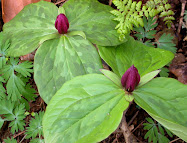
However, trilliums were everywhere. Around here we call this variety by the common name Wake-Robin but the scientific name is Trillium erectum.  I love the way it is divided up into three parts.


Another abundant flower along the river was Dicentra cucullaria (Dutchman’s breeches).

Nearby was Squirrel Corn (Dicentra canadensis) in the same family, Papaveraceae. Below you can see how similar they look. Usually if it isn’t in flower the best way to tell the difference is to dig them up and look at the corms, which by the way are also edible. But as I was looking at the leaves I noticed that those of the Dutchman’s Breeches were just a little more delicate than the Squirrel Corn.


Virginia Blue Bells (Mertensia virginica) were in full bloom.  I think it must be a brave insect to venture deep into this bell.  They are more commonly pollinated by butterflies that can perch on the edge and unroll their long proboscis to sip the nectar inside.  I didn’t see many butterflies so perhaps it is also pollinated by moths.

This Grapevine Epimenis (Psychomorpha epimenis) moth might be a good candidate. It was flying ahead of us along the path.

Here is the only Jack in the Pulpit (Arisema triphyllum) that we found and of course I couldn’t resist lifting the hood up to take a photo of “Jack” (spadix).


We also came across this Bowl and Doily Spider (Frontinella communis) female.  She is big and fat and looks to me like she overwintered.

This day was certainly a spring tonic composed of many ingredients both to digest and to see and my mind and body were both invigorated by sunset.  I highly recommend it for everyone, especially the spring walk.


You might want to stop by another blog called Today Flowers by clicking here.

Sunday, February 5, 2012

Spider egg sacs in winter and cedar apple rust

On the first day of February we had usually warm weather with the temperature up in the high 50’s to low 60’s. So it was perfect for a winter walk without slipping and sliding on the ice. I didn’t start out until around 4 o’clock so I chose to go to nearby Shannondale Spring WMA, just up the road. My goal actually was to exercise but it is difficult for me to not stop and look for signs of insects.

Once I was up by the big meadow I stopped to look in the Pines and Junipers. There are usually egg cases for Mantis in these trees and sure enough I found two in one of the smaller trees.

Next I spotted two spider egg sacs right next to each other. One below is  the egg sacs of Mecybigea lemniscata a member of the Araneidae family.  They are called basilica orb weaver spiders because their webs look a little like the old roman basilicas. They build a orb web and then pull it up from the middle to create the dome. The strand that these eggs are hanging from is very strong and looks like a thin string.  I found several more on other trees. The sacs are held together by a covering of a thin layer of white silk.


The other egg sac I believe was from a Brown Widow , Latrodectus geometricus in the Theridiidae family. The egg sac is actually a spherical egg sac but it is covered with regularly spaced tufts of silk.

Then I found this curious looking thing. At first I thought it was an insect egg case, then a gall and finally I concluded it was Gymnosporangium juniper-virginianae (Cedar-apple Rust).  This is the first time I have focused on a rust and found it very interesting. This plant pathogen uses juniper and apple trees to complete its life cycle.  On the apple tree the infections occur on the leaves, fruit and twigs. It is appears as brightly colored spots that develop tube-like structures on the under surface of the leave in late summer.  On the cedar host, the fungus produces reddish-brown galls from ¼ to 1 inch in diameter with small circular depression with a pimple-like structure in the middle.


In the April and May these elongate into orange gelatinous protrusions that bear spores during the rainy periods. The wind carries the microscopic spores to infect apple leaves creating a complex cycle alternated between the two host plants. In July and August, spores from the apply leaves are produces and the wind carriers them to the cedars where they germinate and produce first a small, green brown swelling about the size of a pea and then to the larger mature gall I found.


Wednesday, October 19, 2011

Shenandoah River Walk

I love to walk along the Shenandoah River this time of year. The leaves and reflection in the water are stunning.


Of course I am still looking for spiders and I found this one from the genus Tetragnatha. There are 25 species in North America to choose from I think this one is Tetragnatha straminea. Also notice how long the legs are; they are about ten times the length of the carapace.


It is a long-jawed orb weaver and you can see the large chelicerae in this photo. They have long, slender abdomens as well. They make orb webs but I didn’t see its web. They catch prey using the web in the traditional sense but they also capture flies and other insects without the aid of a web.


They often can be seen stretched out on a twig or leaf and are almost impossible to see. The egg sac is a tightly woven sac sparsely covered with threads of beadlike, greenish silk attached to twigs and other objects. I looked but didn’t see anything like this nearby.


The walk along the river was really nice. Spice bushes are always good places to search for insects and it smell so nice as I turn over leaves.


To my surprise I found this fun looking colorful caterpillar out in the open. It is a Spicebush caterpillar (Papilio troilus) pretending to look like a snake. I think Disney should make a movie about caterpillars. This one could be one of the main characters. When it is in the early stages of growth it looks like bird poop so there could be a lot of fun teasing about that in the movie.


I have this whole cast of caterpillar characters in my head and maybe later this winter I will do a blog featuring them. For now I just want to show this one.


Here is a photo of two adults taken at an earlier time.


When I turned around to go back to my car I spotted a Praying Mantis eating a couple of bees.

Hello, do you want to join me? I have two bees.

They are very yummy.


 Most of the flowers were gone and I didn’t see any mushrooms but these three insects were great finds on such a beautiful day.


Friday, October 14, 2011

Neoscona crucifera

Neoscona crucifera is a member of the Araneidea family. She is an orb webweaver and likes to sit head down in the middle of her web waiting for prey.


Visit Skywatch Friday by clicking here.


Tuesday, October 11, 2011

Full Moon


Larinioides cornutus (Furrow Orbweaver)


See other interesting photos as Wordless Wednesdays by clicking here.

Wednesday, October 5, 2011

Nursery Web Spider (Pisaurina mira)

Pisauriana mira (Nursery Web Spider) are very common and often seen scurrying along the forest floor. They are in the Family Pisauridae and about the same size as Wolf Spiders.

Nursery Web Spiders are often found in gardens and you can see below one in my leaf lettuce that looks fat and full of eggs. I read that they eat a lot of those tarnished plant bugs and other garden insect pests.


Here is a link to an earlier blog I did on spider egg sacs: http://squirrelsview.blogspot.com/2010/11/spider-egg-sacs.html You can scroll down and see the Pisauriana carrying her egg sac to a good location.


The interesting thing about Nursery Web spiders is, well, the nursery. After carrying around the sac of eggs she finds a good location and begins by tying leaves together with silk. She then suspends her egg sac within and waits nearby for them to hatch. I believe she stays on guard at least until after their first molt, about a week. I find this interesting because most insects that lay and abundance of eggs don’t protect their offspring. The thinking is that there are so many, so they play the odds that enough will survive but not Pisaurina mira, she hangs in there to ensure survival.

Here is an addition to my previous post on spider eggs sacs. This is not a large furry egg but rather a large group of spiderlings huddled together.  When I approached they all scattered.  You can see the recently molted skins.


When the male Pisaurina mira come courting he brings his intended a fly as a gift. He is planning on having his way with her while she is eats and not be interesting in eating him. I would love to see this in action but so far no luck. 

Check out Nature Notes.