Showing posts with label Fungi. Show all posts

Wednesday, October 26, 2011

Staufers Marsh

I stopped at Staufers Marsh last weekend to show a friend where it was and to tell her a little of what could be expected. The morning mist was still over the water enhancing the emptiness or so it seemed. We were looking for birds but instead we found insects.


This time of year Praying Mantis are full grown and ready to ensure their gene pool carries on. We found several eggs cases attached to the small trees just inside the fence, most of which had been hacked into and emptied of eggs. From the looks of them I think they are made by European Mantis (Mantis religiosa).


So when I spotted this mantis hanging on by one leg I concluded it too was a European Mantis. The morning was still cold and I think she was just hanging out until it warmed up. I did notice a little movement as I took photos but I didn’t want to disturb her. Later in the day we returned and she was gone. This one was tan but usually they are green. They were first introduced to our continent from southern Europe in 1899 on a shipment of nursery plants.


On the same small evergreen we spotted these sawflies. My friend recognized them right away because she has a dwarf evergreen collection in her yard and they are a big pest for her. I believe these are Neodiprion lecontei (Redheaded Pine Sawfly).


The best way to tell if they are sawflies and not moth or butterfly caterpillars is to look at the prolegs. The sawfly prolegs almost fill up the full length of the body because there are six or more pairs and butterflies and moths have five or fewer prolegs. I’m not sure what that bubble of liquid is at the tip of its mouth. They all had it but when we came back later in the afternoon the bubbles were gone.


Next we drove up to Sleepy Creek WMA to explore some more starting at the lake where I was last week. Most of the trees had turned yellow but some of the leaves at the lake were so red they almost didn’t look real.


My friend pointed out this nice clump of fruticose lichen. It is similar to British soldiers but the caps are pinkish tan instead. One of my fellow bloggers said that she finds these lichens in New York and that they are Pink Earth Lichen (Dibaeis baeomyces). She is an excellent naturalist and I'm confident she is correct.

The fungus of the day was a tiny tooth fungi called Irpex lacteus (Milk-white Toothed Polypore). At least that was our best guess. I don’t often see toothed fungi so I was grateful that my friend tramped through the weeds to get a sample.


The next odd thing we found was Wolf’s Milk Slime mold (Lycogala epidedrum). Often they are more pinkish but these had the more mature color of dark tan. We squeezed one open and it was a pinkish gray paste inside that will eventually turn to spores.


The last photo I took at Sleepy Creek was of this beautiful Common Buckeye butterfly (Junonia coenia). They have been very common this year but still I was pleased to see one so late in the season.


I was trying to take a photo of the dorsal (top) side and was slightly disappointed to get this one of the ventral (underside) side. Now I am glad I did because after reading more about them I discovered that they exhibit seasonal polyphenism; a new term for me. So in the summer they are light yellowish on the underside and that version is called “linea”. This fall morph has pink ventral wings and is called the “rosa” morph.


I just never know when I am going to learn another cool fact. Natural history is great isn’t it!

Tuesday, October 11, 2011

Colorful and odd shaped Mushrooms

Last weekend my friend Jane came up from DC to explore and look for mushrooms. When we started out it began to drizzle rain but we went ahead with our plan. What’s a little rain to stop naturalist! I must admit I was a little concerned for my camera but off we went.

Our first good find was a colony of Clavaria pyxidata, Crown-tipped Coral mushrooms or they could be Ramaria stricta, I just can’t decide. There must have been 30 or more in very large clumps. Roody in Mushrooms of West Virginia writes that they are edible but I’m just not ready to taste these just yet. He claims they taste mild to peppery. I think they are pretty and that’s enough for me.


I was thrilled when Jane pointed out these earth stars. I believe they are Geastrum fimbriatum. The rain has made them glossy looking and they almost sparkle don’t they. I asked Jane to squeeze one so I could get a photo of the spores coming out but I didn’t get the photo and she got a face full of spores. I don’t think she will do that again even if I begged.


We saw many other mushrooms that we didn’t identify before the rain began to really come down and we had to leave.

Then last Friday after work I drove back up to see if I could find more and I was blessed with these two bright orange ones. I believe they are Hygrocybe cuspidate, Candy-apply Waxy Caps. With that red color you would think they were poisonous but they are not.


There were plenty of regular shaped mushrooms all about but I was going for the more exotic looking ones such as this Clavulinopsis aurantio-cinnabarina. That’s a mouth full isn’t it? The common name is Orange Spindle Coral. I found some twice the size of this one but I’m showing you this because I have my hand there for scale. They can get up to 5 inches, but I think I only saw some up to 4 inches. At first it seemed like there was only one but once I started looking I could see them all around.


I was also going for the colorful when I photographed these Lemon Drops, Bisporella citrine. They are one of the most common cup fungi in my area. This log was covered with them.


I walked on up the hill to find the earth stars again but found this box turtle instead. He seems to have all the fall colors of the mushrooms in his face. He doesn’t look too happy but I suspect he has inner peace if not a joyful face.


I didn’t find the earth stars but I did find this Pestle-shaped coral, Clavariadelphus pistillaris. If you look closely on the left side you can see the teeth marks of something that ate its way along. I think it was a tiny snail.


As I was getting back into my car I saw some movement and followed a chipmunk to its hideout. I guess it thought I couldn’t see it and was very still and watchful. I was rather surprised because there are so many squirrels about that I rarely see a chipmunk at this end of the mountain.


It was getting late so I took this parting shot before I drove home. It was truly a perfect and colorful day.


Wednesday, August 17, 2011

Late summer walk in the woods

My latest trip up to Sleepy Creek WMA was one of variety. It was like I was finding one of everything. At the hair pin turn I stopped to see what was on the Joe Pye Weed and was rewarded with this Great Spangled Fritiliary (Speyeria cybele).  I have photos of it showing the back side but I liked this one showing it's eyes the best. They are a member of the Brush-footed butterflies, family Nymphalidae. It lookes like it only has 2 pair of legs but that brisly looking stuff under its face is the 3rd pair that it gets it's name from. You can also see it's proboscus dipping into the nectar of the flower. This is a large butterfly sinilar in size to a Swallowtail.


Along the side of the road I spotted some early blooming asters.  These are Aster schreberia at least that is what I think they are. It is a light purple flower with a yellow center that turns redish and that is how my field guide described them.  This one had one of those little green sweat bees (Halictidae) feeding on it.


Crossing the road was a Buck moth caterpillar (Helimeuca maia). I usually see a couple of these a year, in fact I see the catpillar more often than the moth. This is definately a caterpillar you don't want to pick up.  In David Wagner's book, Caterpillars of Eastern North America, he wrote, "Stings that I received on the back of my hand from a Buck Moth caterpillaer were visible 10 days later...."  You got to give them credit though, they do give fair warning.


There were lots of yellow composits but for the life of me I cannot really tell one from another.  But I did see Dogbane that was old and beginning to go to seed and of course it had this lovely Dogbane Beetle (Chrysochus auratus) chomping away. That reflective color is really amazing isn't it.  It is missing one of its beaded shaped antennae, a type that is common to beetles. Day flying insects have shorter antenea because they can also see well, unlike the night insects that need to "feel" their way in the dark.


Speeking of night flyers I found this moth hanging upside down, I guess it was trying to look like a dead leaf but not really succeeding. It is female Imperial Moth (Eacles imperialis). Looks like she had a rough night.
 

I thought it was dead and when I touched it she dropped to the ground which was really a better hiding place because she just blended in with the few old and dead leaves.


As I walked up to this large mushroom I noticed the nauceous odor and the insects buzzing around it. I guess they thought it was rotting meat. I had seen this one before but for the life of me I couldn't remember what it was so I took this photo and went back to the car to look it up. 


It looked similar to a few others but still I wasn't sure so I got out a small trowel I use for collecting mushrooms and trotted back to dig it up and sure enought there was the answer: Carrot-foot Amanita (Amanita daucipes).  It even had the ring that had fallen off the stalk laying at the bottom near the base just as describe in my field guide. With a root like that it was easy to stick back into the ground.


Of all the species I saw that day this one was my favorite.  Like Luna Moths, the Praying Mantis seems special to me.  There are several species of mantis in my area but I think this one is a young European Mantis (Mantis religiosa) the one that the common name comes from.  I say it is young because you can see it's wings are not fully developed. I imagine it saying, "Oops, sorry, I didn't mean to bite your head off".  I think that would make a nice card don't you?


Visit OUTDOOR WEDNESDAYS for more interesting outdoor blogs

Sunday, July 31, 2011

Balanced Rock Trail

The day after the Mushroom Foray my nature buddy and I took a walk out to Balanced Rock. It had rained that morning until about 10:00 and the trail was like a small stream and the footbridge we crossed the previous day was now partially under water. But that didn’t deter us and soon we were at Balanced Rock.


In the next photo you can see where the water partially covered the bridge and the tannin stained water that Blackwater is named after.


Below are some of the many Indian Pipes (Monotropa uniflora) we saw. They are often seen when looking for mushrooms but they aren't a mushroom. In fact they are a parasite to mushrooms, most commonly the Russula and Lactarius mycelia.  Since Indian Pipes have no chlorophyll they tap into the mycleia to take up the needed nutrients.


Here are a few interesting mushrooms that we saw on the second day.

Amanita flavoconia (Yellow Patches) is a do not eat mushroom.


Entoloma salmoneum (Salmon Unicorn Entoloma) is another one you don't want to eat.
Balanced Rock was created by a difference in the rate of weathering. Sceintifically it is called Differential weathering. The top rock has with stood the elements better than the rock on the bottm and left them in this precarious position called a table rock.

Here is a close up of the conglomerate sandstone from the Pottsville Group that makes up the Balanced Rock.

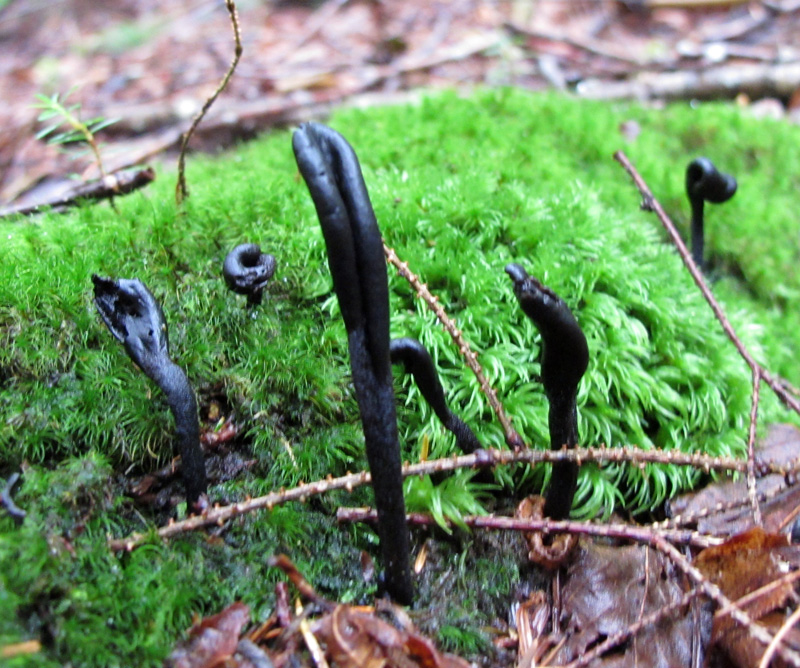
My nature nerd buddy, Trillium, pointed this Velvety Black Earth Tongue (Trichoglossum hirsutum) to me. Once I saw it and had a search image in my head I could see it everywhere. We were surrounded!  These are in the group commonly called Club Fungi.

Velvety Black Earth Tongue (Trichoglossum hirsutum)

This next one is a Coral Fungi and you probably think I did something to it to make it this orange but believe me I didn't, the light was just right and it almost glowed.

Orange Spindle Coral (Clavulinopsis aurantio-cinnabarina)

Velvet-foot Fairy Fan (Spathulariopsis velutipes). They do look like tiny little fans don't they!
The Rhododendron maximum, or “great laurel,” is the state flower of West Virginia.

For the first time I really took note of those green markings on these flowers. Actually Trillium pointed them out to me but we weren't sure what they are used for.  Do any of you know?

From there we drove over to see how the rain had effected the falls. It was the fullest that I had ever seen.  All in all it was a wonderful day in a Wild and Wonderful West Virginia.

To visit other outdoor places online see Outdoor Wednesdays by clicking here.

Friday, July 29, 2011

Mushroom Foray

During the heat wave along the east coast, thankfully I was in a cooler part of WV. I had planned the trip earlier in the year but totally lucked out that it occurred when it did. The WV Mushroom Club had their Mid-Summer Mushroom Foray at Blackwater Falls where it is about 15 degrees cooler. The previous few days and the days we attended it rained each morning which created perfect mushroom hunting weather.

Amanita fulva (Tawny Grisette)

 In the morning we were treated to a short introduction and they we gathered into groups to go out and collect. There were about 80 participants but we had a number of experts so each group was small. Everywhere we looked there were mushrooms, I have never seen so many in such a small area.

This coral mushroom is one of my all time favorites Clavicorona pyxidatus (Crown Tipped Coral).


Amanita sp.

Bill Roody, author of Mushrooms of West Virginia and the Central Appalachians, led the group I was with. We not only collected but he taught us about each find as we slowly progressed through the rich forested area. The trail had a rich, loamy, woodsy smell of a healthy forest.

Bill Roody


Just before we turned back I took this photo of a slug on a mushroom and one of the top showing where it had been eating.  They seem to prefer bollets just like we do. 

Signs of slug chowing down. Below you can see one of the culprits on the underside. Slugs make large, irregular pits where they feed.


My friend showed me this polypore with the marks of a snail. Both snails and slugs use a radula for feeding instead of teeth like mammals.  The radula is a chitinous ribbon with tiny teeth that is pushed against a mushroom or polypore to feed. The radulas can "rake" to comb algae from a surface or "rasp" to feed dierectly on a mushroom. These marks look very similar to those made by the snail Stylommatopora as it moves its head side to side feeding along the way.


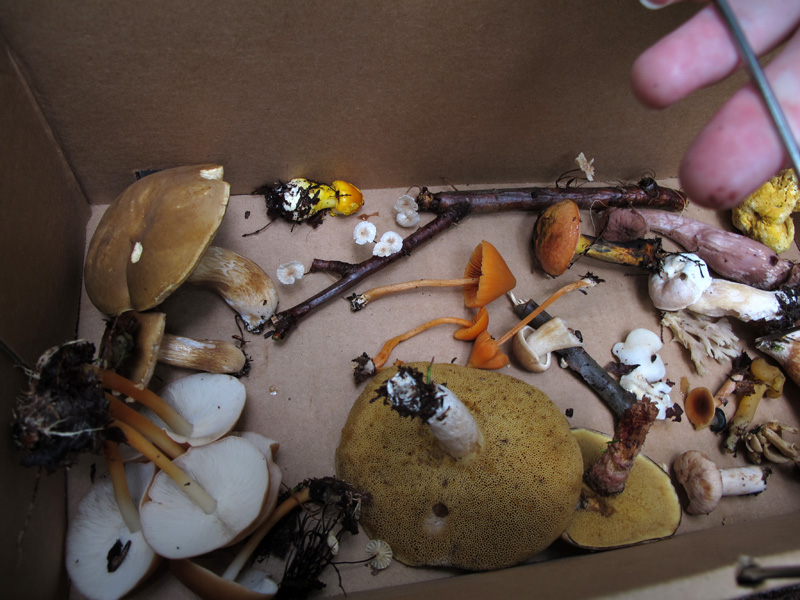
Everyone had baskets or paper bags to carry our finds. With mushrooms you don’t want to put them into plastic bags because they will begin to rot and you also need to keep them from getting squashed or broken. Here is the inside of Ryan’s basket and you can see he had a good variety and this was at the start of the search.

Our goal was to take our finds back to the lodge where we sorted them and the experts began to identify and place labels on them. Later that afternoon after a potluck lunch Bill and our other expert Gary Linkoff, author of the National Audubon Society Field Guide to North American Mushrroms and the Complete Mushroom Hunter, told us about each of the mushrooms we found. They pointed out identifying characters and some of the history and lore associated with them.


After lunch the main speaker, Gary Linkoff, gave a talk on Polypores which was both entertaining and educational.
Gary Linkoff


Chantarellus minor is a choice muchroom for eating.