Showing posts with label SCWMA. Show all posts

Wednesday, October 26, 2011

Staufers Marsh

I stopped at Staufers Marsh last weekend to show a friend where it was and to tell her a little of what could be expected. The morning mist was still over the water enhancing the emptiness or so it seemed. We were looking for birds but instead we found insects.


This time of year Praying Mantis are full grown and ready to ensure their gene pool carries on. We found several eggs cases attached to the small trees just inside the fence, most of which had been hacked into and emptied of eggs. From the looks of them I think they are made by European Mantis (Mantis religiosa).


So when I spotted this mantis hanging on by one leg I concluded it too was a European Mantis. The morning was still cold and I think she was just hanging out until it warmed up. I did notice a little movement as I took photos but I didn’t want to disturb her. Later in the day we returned and she was gone. This one was tan but usually they are green. They were first introduced to our continent from southern Europe in 1899 on a shipment of nursery plants.


On the same small evergreen we spotted these sawflies. My friend recognized them right away because she has a dwarf evergreen collection in her yard and they are a big pest for her. I believe these are Neodiprion lecontei (Redheaded Pine Sawfly).


The best way to tell if they are sawflies and not moth or butterfly caterpillars is to look at the prolegs. The sawfly prolegs almost fill up the full length of the body because there are six or more pairs and butterflies and moths have five or fewer prolegs. I’m not sure what that bubble of liquid is at the tip of its mouth. They all had it but when we came back later in the afternoon the bubbles were gone.


Next we drove up to Sleepy Creek WMA to explore some more starting at the lake where I was last week. Most of the trees had turned yellow but some of the leaves at the lake were so red they almost didn’t look real.


My friend pointed out this nice clump of fruticose lichen. It is similar to British soldiers but the caps are pinkish tan instead. One of my fellow bloggers said that she finds these lichens in New York and that they are Pink Earth Lichen (Dibaeis baeomyces). She is an excellent naturalist and I'm confident she is correct.

The fungus of the day was a tiny tooth fungi called Irpex lacteus (Milk-white Toothed Polypore). At least that was our best guess. I don’t often see toothed fungi so I was grateful that my friend tramped through the weeds to get a sample.


The next odd thing we found was Wolf’s Milk Slime mold (Lycogala epidedrum). Often they are more pinkish but these had the more mature color of dark tan. We squeezed one open and it was a pinkish gray paste inside that will eventually turn to spores.


The last photo I took at Sleepy Creek was of this beautiful Common Buckeye butterfly (Junonia coenia). They have been very common this year but still I was pleased to see one so late in the season.


I was trying to take a photo of the dorsal (top) side and was slightly disappointed to get this one of the ventral (underside) side. Now I am glad I did because after reading more about them I discovered that they exhibit seasonal polyphenism; a new term for me. So in the summer they are light yellowish on the underside and that version is called “linea”. This fall morph has pink ventral wings and is called the “rosa” morph.


I just never know when I am going to learn another cool fact. Natural history is great isn’t it!

Wednesday, August 17, 2011

Late summer walk in the woods

My latest trip up to Sleepy Creek WMA was one of variety. It was like I was finding one of everything. At the hair pin turn I stopped to see what was on the Joe Pye Weed and was rewarded with this Great Spangled Fritiliary (Speyeria cybele).  I have photos of it showing the back side but I liked this one showing it's eyes the best. They are a member of the Brush-footed butterflies, family Nymphalidae. It lookes like it only has 2 pair of legs but that brisly looking stuff under its face is the 3rd pair that it gets it's name from. You can also see it's proboscus dipping into the nectar of the flower. This is a large butterfly sinilar in size to a Swallowtail.


Along the side of the road I spotted some early blooming asters.  These are Aster schreberia at least that is what I think they are. It is a light purple flower with a yellow center that turns redish and that is how my field guide described them.  This one had one of those little green sweat bees (Halictidae) feeding on it.


Crossing the road was a Buck moth caterpillar (Helimeuca maia). I usually see a couple of these a year, in fact I see the catpillar more often than the moth. This is definately a caterpillar you don't want to pick up.  In David Wagner's book, Caterpillars of Eastern North America, he wrote, "Stings that I received on the back of my hand from a Buck Moth caterpillaer were visible 10 days later...."  You got to give them credit though, they do give fair warning.


There were lots of yellow composits but for the life of me I cannot really tell one from another.  But I did see Dogbane that was old and beginning to go to seed and of course it had this lovely Dogbane Beetle (Chrysochus auratus) chomping away. That reflective color is really amazing isn't it.  It is missing one of its beaded shaped antennae, a type that is common to beetles. Day flying insects have shorter antenea because they can also see well, unlike the night insects that need to "feel" their way in the dark.


Speeking of night flyers I found this moth hanging upside down, I guess it was trying to look like a dead leaf but not really succeeding. It is female Imperial Moth (Eacles imperialis). Looks like she had a rough night.
 

I thought it was dead and when I touched it she dropped to the ground which was really a better hiding place because she just blended in with the few old and dead leaves.


As I walked up to this large mushroom I noticed the nauceous odor and the insects buzzing around it. I guess they thought it was rotting meat. I had seen this one before but for the life of me I couldn't remember what it was so I took this photo and went back to the car to look it up. 


It looked similar to a few others but still I wasn't sure so I got out a small trowel I use for collecting mushrooms and trotted back to dig it up and sure enought there was the answer: Carrot-foot Amanita (Amanita daucipes).  It even had the ring that had fallen off the stalk laying at the bottom near the base just as describe in my field guide. With a root like that it was easy to stick back into the ground.


Of all the species I saw that day this one was my favorite.  Like Luna Moths, the Praying Mantis seems special to me.  There are several species of mantis in my area but I think this one is a young European Mantis (Mantis religiosa) the one that the common name comes from.  I say it is young because you can see it's wings are not fully developed. I imagine it saying, "Oops, sorry, I didn't mean to bite your head off".  I think that would make a nice card don't you?


Visit OUTDOOR WEDNESDAYS for more interesting outdoor blogs

Thursday, July 28, 2011

Deer Fly eggs


If you have been reading my blog this spring and summer you will have noticed that I have been looking for tracks and signs of insects and my afternoon at Sleepy Creek WMA was no exception. While I was down by the lake in one of the coves I was looking for dragonfly exuvia and was rewarded with these deer fly eggs.


They are in the family Tabanidae, genus Chrysops but other than that I don’t know the species of these. I did happen to see a fly laying eggs but by the time I moved closer and focused my camera it had flown, leaving this very white mass of freshly laid eggs. They lay the eggs in tiers which contain a few to several hundred eggs. The eggs are cylinders measuring from 1 to 2.5 mm long. Their choice location is on vegetation which hangs over water so I was in a prime spot along this lake where the vegetation is not too dense. The eggs first appear white as in this photo and later turn brown as in the first photo and then almost black as in the last photo. I thought myself lucky to have found all three stages in the same area.


After about 4-5 days the eggs hatch and the larvae drop down and burrow into the soil. They will overwinter and mature in late spring.

Like mosquitoes the female requires a blood meal before laying her eggs. The bite can be very painful so if you see a large fly ¼ to ½ inch long with yellowish markings, clear wings with black or brown pattern that look like bands, shoo her away before she bites you. The males are probably feeding on nectar or protecting territory and could care less about the blood running through you veins.

In the past when I walked through the woods I would see stuff like this and keep going. Now I have learned to stop and really look at new, odd and strange things and I have found them quite intersting.  It gives me more of a connection and appreciation for the lives of other creatures on our planet.

Tuesday, July 26, 2011

Afternoon at Sleepy Creek

The heat dome over the east coast was getting to me so I drove up to Sleepy Creek Wildlife Management area. It is about 5 degrees cooler and at that point every degree counted. Besides I hadn’t been up there for a while and I was hoping to find some butterflies.

Great Spangled Fritiliary

Driving down the dirt road toward the lake I was finding a lot of flowers in bloom but not as many butterflies as I expected. So since I am trying to learn summer wildflowers I took the opportunity to look at them without being distracted. First up was Spotted Knapweed.


Spotted Knapweed (Centaurea maculosa)
Goldenrod (Solidago juncea) and


I also noticed this goldenrod bunch gall. Usually I don’t notice them until the fall.


Below is Yellow stem Agrimony (Agrimonia gryposepala)
Agrimony (Agrimonia gryposepala)
St. Johns Wort (Hypericum perforatum)

Deptford Pink (Dianthus armeria)

But most impressive of all was this tiny flower called Yellow Goat's Beard (Tragopogon pratensis).

It doesn’t look impressive here but take a look at the seed head below. It was like Gulliver in the Lilliputian world of dandy lions only it isn’t a dandy lion.


Here is a few of the seeds.


As I drove on down toward the lake I passed a lot of White Sweet Clover (Melilotus alba) at least I think that is what this is.

White Sweet Clover (Melilotus alba)


Finally at the like is where I found most of the butterflies.
Spicebush Swallowtail

Of course there were some nice Odonata as well.

A couple of damselflies mating.
The female is in the back and lifted her ovipositor up to collect the sperm from the male.


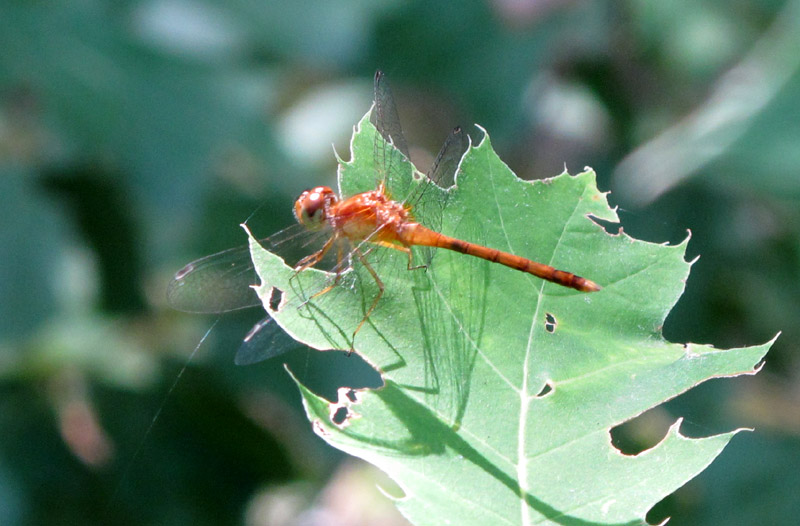
I'm not sure what this dragonfly is because it just hatched and in a stage called "teneral". The wings are shinny and still soft which makes them very vulnerable at this time because they fly so slow.
Calico Pennant (Celithemis elisa)


Dogbane Beetle (Chrysochus auratus)
Here is a delightful youtube video about Dogbane beetles.


On my way home I stopped to pick some wineberries. Yummy!


Stop by Outdoor Wednesdays for more adventures outside. Click here.

Wednesday, August 18, 2010

Afternoon with insects

A few weeks ago I took a trip up to Sleepy Creek Wildlife Management Area just to see what I could discover.  After the Nature Leadership Training course I have been very aware of insects so it is no surprise I found lots of them. But I was surprised to see the variety and a couple of new ones for me.

On the road leading to the lake I made a couple of stops to take photos of the butterflies. This year we seem to have an abundance of Eastern Tiger Swallowtails and I never tire of looking at them.

Eastern Tiger Swallowtail --Papilio glaucus

Silver-Spotted Skipper (Epargyreus clarus) is the largest skipper in my area. Here it is nectaring on thistle.

I saw a few of these metallic colored Dogbane Beetles (Chrysochus auratus). They look even shinier than in this photo.

Here is a member of the Diptera family, a Bee fly.  It was mimicking a bee but I wasn't fooled.


That bright orange insect is a day flying moth.  It also flies at night and often comes to my porch light. It is an Ailanthus Webworm moth (Atteva punctella).  The larval form feeds on Ailanthus (Tree of Heaven).


This cove on Sleepy Creek Lake is one of my favorite spots.  I have even seen beaver here and countless numbers of dragonflies. Today I found a couple of new insects.

Hummmm....what is inside this leaf roll?

When I opened it up this walking stick like insect quickly crawled out. Eventually it settled down and aligned itself with the mid-vein of this leaf  thinking it was hidden from view. I didn't get a good photo but it actually laid down on the vein and drew its legs to its sides and pointed the antenna forward. I probably wouldn't have noticed it if I didn't see it crawling around first.  This is an assassin bug in subfamily Emesinae of the Reduviidae family. The common name is Thread Legged Bug. 


Aphids but something is missing...ants.  I don't recall ever seeing aphids without ants nearby.  Ants guard aphids and in turn sip the honey dew that they excrete.  Below is a close up that I took through my hand lens and you can see the tiny drops just waiting to be harvested.  I wonder what happened to the ant colony.


I just finished reading E.O. Wilson's novel Anthill and I wondered if the ants that usually farm these aphids were taken over by a super colony as described in his account of the demise of the Trailhead colony.  Without ants taking the honey dew I am curious to know what will happen to these aphids and all that liquid at the end of their butts.

 
Dragonflies were all about. This one is a Yellow-legged Meadowhawk - Sympetrum vicinum.


Another rolled up leaf brought this spider to my attention. 


It is a Paraphidippus aurantius female spider and the very bright orange and metallic green is caused by iridescent scales. They are not very common and usually found in folded leaves like this one.  I chased it all around the the leaf trying to get a photo and it did not drop down to the ground like most spiders do. I suspect this one had eggs inside the leaf that it was guarding.  I also think it was eating.


This little critter crossed my path as I was leaving the banks of the lake.  It is a Spring Peeper and was blending in very nicely.  If I hadn't seen it hop I would never have found it. I can't even imagine all of the critters that was watching me that I wasn't even aware of.

See more nature at Outdoor Wednesdays.