Showing posts with label Outdoor Wednesday. Show all posts

Wednesday, April 14, 2010

Bee Fly

Bee Flies (Bombylius major) were in abundance last weekend when it was bright and sunny out. Usually I might see one but on that day I saw several. I was looking for bees and I think so were the flies. I always thought their only relationship to bees was that they had the same fuzzy butts that some bees have but their story is a little more complicated than that.


They prey on bees! Or at least their larvae prey on bee larva. I guess that is like saying, “my kids, eat your kids.” Gruesome! Anyway, they lay their eggs near the entrance to the bee’s nest, mostly solitary bees that nest in the ground. Some species sort of flick their eggs into the holes. There are over 5,000 bee flies worldwide so I am generalizing here. The parasitoid larvae enter the hole and begin feeding on the food storage for the host bee larvae and eventually eats the host bee larvae as well. Now get this, later when the bee fly larvae is more mature it turns into a grub-like larvae before it become a bee fly. This is called hyper-metamorphosis. Frankly I’m glad this all goes on underground.


Above ground in the sunshine the bee flies are a lot of fun to watch. The proboscis is long and points forward and they feed on many of the same flowers that bees do. However they hover over the flower like a Clearwing moth or Hummingbird, I guess that is why they need the long proboscis. This seems to be a good strategy to keep clear of predators like crab spiders lurking between the flower petals.


Isn't it cute!

Wednesday, March 31, 2010

Nectar Robber


On my way home tonight I decided to stop down by the Shenandoah River to see what I could see. The water was very high and passage along the bank was impossible. So I decided to walk back down the road to check out the Dutchman's Breeches I spotted as I drove in. Last week or so I wrote about finding some that had just started to come up. Well, now they are in full bloom and mixed in with the Bloodroot. When I was doing research about Dutchman's Breeches I read that they are pollinated by long tongue bees but occasionally other bees will cut holes in the sides and rob the flower of its nectar bypassing the pollen. So I decided to see if I could find evidence of that happening to this stand of flowers. Sure enough almost everyone had slits in then.


I read in my hot-off-the-press "Tracks and Signs of Insects and Other Invertebrates" by Charley Eiseman and Noah Charney that large carpenter bees, Xylocopa species, use their proboboscis to cut narrow slits in the flowers to gain access.


The photo in the guide show the tips bitten off by nectar-robbing bumblebees (Bombus) but the ones I was seeing were more like slits so I have concluded they were made by the Xylocopa species.

See more interesting things at Outdoor Wednesdays.

Monday, March 8, 2010

The perfect day

Everyone has their own favorite season and for me it is early spring when there is hope in the air yet still the possibility of another winter day. Today was the perfect early spring day. Usually I look for amphibians on this day but because of the hugh amount of snow last month the amphibians are a little behind in their breeding. So I set off to find snow fleas in the remaining snow along the Blue Ridge Tract road. I have never seen them and after reading blogs from New Yorkers about their finds, well I couldn’t be out done.


As I approached the wetland area I saw a pair of Wood Ducks fly up and move further back into the wetland. It was a good site because I had not seen any of them for several years. As I looked around I realized that the weeds and briars were all flat against the ground as a result of the heavy snow. It was now actually possible to walk along Furnace Run without getting hopelessly stuck in the stickers. So off I went to follow the run from the wetland, a first for me. The run curves and winds around creating beautiful scenes at every bend.
Here is a spot on a log where a squirrel stopped to eat hickory nuts. You can see the tiny teeth marks


and scat left on the tree.


The next really cool find was a Skunk Cabbage (Symplocarpus foetidus). Actually I should probably say the next “hot item” since they get up to 15 to 35 degrees centigrade and melt the surrounding snow.


Look inside; it looks like a furnace in there. Amazing isn’t it! I’ve always admired the colors on the outside and never photographed the inside before. It seems there is always more to learn, even about the plants and animals I am already familiar with. It is the same way with friends and lovers. Taking the time to look inside can be full of wonderful surprises.


I had been taking photos of some interesting wood textures like this one…


So when I saw a interesting white section on a fallen tree I moved in close to take the photo. To my surprise and delight I found SNOW FLEAS! I wonder if they are just attracted to the white surface like snow to get the reflective heat. I first read about Snow Fleas when I was learning about Wood Frogs. The tiny toadlets love to eat them when they first hop out of the vernal pool of their birth.


They are 1-2 mm long springtails and look like 6 legged Michelin tire men.
You can click on all the photos for larger views.


Well, at this point I was a happy camper and could turn back but the day was still young, even though I was a year older. Returning to the fire road I checked on the snake eggs


and bird nest I found last fall


and took another photo of the Tent Caterpillar egg cases on the cherry tree.


Assured that all was well, I headed on home.

 
Visit more Outdoor Wednesday.

Tuesday, February 23, 2010

Frog Calls

While I was at the National Botanical Garden I heard a frog call. I almost felt my ears turn to locate the source of the call but was reminded that it was probably a recording, besides I didn't recognize the call. So I thought today I would give some verbal descriptions for common frog calls that can be heard in the Eastern Panhandle of West Virginia.  I copied these from class notes and have no idea who originated these good descriptions but I am very grateful for the person who first wrote them down and passed them along to other frog lovers. I wish I had photos of all the frogs but so far I am missing a few. Perhaps this year I will be able to take a photo of a few more.  The beginning of March we should start hearing Spring Peepers and Wood Frogs.  Keep a look out for them on warm rainy nights.

American Toad – long musical trill “waaaaaaaaaaa…………” lasting up to 30 seconds (range 6-30).


Fowler’s Toad – short unmusical nasal trill “waaaaaaaaaaaa” lasting 1-4 seconds – shorter and harsher than American Toad. Reminds me of someone who ate something foul and is complaining.


Northern Cricket Frog – hesitated clicking “gick, gick, gick” starting slowly then increasing speed for 20-30 clicks. This frog sounds like someone clacking 2 marbles together repeatedly.


Gray Treefrog - hollow musical, wooden trill or similar to call of red-bellied woodpeckers.


Northern Spring Peeper – loud piercing ascending whistle “peep” repeated at 1 second intervals. Our most common calling frog, a full chorus sounds lie sleigh bells and can literally make your ears “ring”.

Upland Chorus Frog – sounds like running your fingernail over the small teeth of a comb “teeeee”, lasts 1-2 seconds, speeding up and rising in pitch at the end. Often heard with peepers, but do not mistake the agonistic call of a peeper for this frog. These are rare in my area but I have heard them near Staufers Marsh in Berkeley County.


Bullfrog – a deep, resonabt, bassy and slog “jog-o’-rum”.


Green Frog – sounds like the twang of a loose banjo string, but explosive, either a single note or repeated 3-4 times, the notes progressively less loud.


Wood Frog – a fast series of short raspy clacking sounds. A full chorus sounds like a flock of quacking ducks.

Northern Leopard Frog – a low guttural snore lasting 1-3 seconds with 20 snores per second, followed by several clucking grunts.


Pickerel Frog – a steady low croak or rolling snore lasting 1-2 seconds.

Visit other Outdoor Wednesday Blogs

Wednesday, January 6, 2010

Snowy walk in the woods


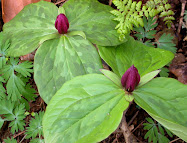
My most recent trip to the Blue Ridge Tract was with Trillium after our big 2 foot snow. By then the rain had melted some of the snow but the ground was still covered in the forest. I always look for insects when I am out and this time I found about five tent caterpillar egg cases on one small cherry tree. Most of them had been eaten into but one was still intact. I brought it home to see them hatch out and study them up close. I didn’t think the tree would mind and I can feed them to the birds.


Down by the wetland area Trillium noticed a hundred or more spider threads floating on the dead stems. Close inspection revealed a very tiny spider at the end of one strand. After they hatch, baby spiders let out a string of silk that blows in the wind. When they are ready they let go of their hold and are pulled away with the flying silk. This is called ballooning. Personally I think it is very gutsy because they have no idea where they will land. She also spotted another spider in a foot print.


We found two interesting fungi. One, seen below, is a type of puff ball. It is called Calostoma lutescens and I have found them before. I was excited to see these puffballs in a new location.


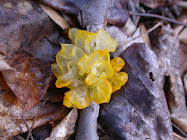
The other interesting fungi we found was a jelly fungi, called Auricularia auricula. The common name is Wood Ear or Tree Ear and according to Bill Roody in Mushrroms of West Virginia it is edible even raw and dries well for future consumption. It almost doesn’t look real but it is.


The thing that most excited us and occupied our attention was the animal tracks we could see in the snow. Deer and squirrel tracks were abundant. Here is a raccoon track showing those charastics toes they have.


The find of the day was Black Bear tracks. It was hard to believe but the size, shape and gait of the tracks didn’t lie. I knew black bears were up there but this was the first evidence I had personally seen.


We followed them up the fire road but didn’t peruse them into the woods. To me they looked old because our own tracks were going much deeper into the snow. I thought the bears would be snuggled up fast asleep by now but in our area they could still be found until January. You can bet this spring I will be looking for scat and other bear signs. Wanting to learn more about tracking I asked a fellow blogger who loves to track for good resources. Ellen Rathbone, replied with a very comprehensive blog on the subject. Be sure to visit her blog Adirondack Naturalist and check out her reply and other pages for examples.


You can also see Trillium’s thought on our walk at her blog simply called “Trillium”. There are signs of life in the woods everywhere and I can’t wait to get back out and look for more.


See more outdoor adventures at Outdoor Wednesdays.

Wednesday, October 28, 2009

Blackwater National Wildlife Refuge

Blackwater National Wildlife Refuge, located on the Eastern Shore of Maryland, is one of my favorite places to go birding in the fall because during October and November as many as 50,000 geese, ducks and tundra swans stop. And there is the important factor that there are fewer biting insects this time of year. Our first stop was the visitor center to pick up a bird checklist, view the displays, and purchase book marks and a patch for my vest.


Next we took a walk through the Loblolly Pine forest out to one of the brackish tidal marshes the refuge is known for. The sky was overcast, the day was dreary and the lack of birds was disappointing. We did see a Belted Kingfisher and Canada Geese.


Our next stop proved to be more fruitful where I enjoyed watching a young Northern Harrier hunt voles. It was so beautiful with its bright rusty breast. One of the endangered Delmarva Fox Squirrels was hanging out in a tree. Blackwater Refuge has the largest population of the grizzled-gray squirrel but you still have to look carefully to see them.


Canada Geese were everywhere and I really enjoyed seeing them fly in from the fields as the day ended. The refuge is one of the main wintering areas for geese along the Atlantic flyway, a major migration route along the East Coast of the United State.


The highlight was seeing the Bald Eagles. A pair was sunning themselves on a tiny island when a Golden Eagle swooped in just to harass them. It was like a nature movie moment. I tried to take photos of the eagle on the tree top but just couldn’t get a good shot. Since the refuge is host to the largest breeding population of Bald Eagles on the East Coast, north of Florida I had plenty of opportunities to try.


I even tried to take a photo through my binoculars. You just recognize that it is a Bald Eagle but that is about it.


On down the way I saw a snake swimming and a Painted Turtle in the water skirting the road.


Even though my photos were lousy that day, being there in all that flat expanse (25,000 acres) and listening to the Canada Geese and Red Winged Blackbirds was enough. One group of Canada Geese flew so low the sound of their wings was almost as loud as their calls. Those are the moments that keep me returning as often as I can.


Be sure to visit more good places at Outdoors Wednesday.

Ring-billed Gull


This Ring-billed gull (larus delawarensis) was photographed at Assateague Island National Seashore October 24, 2009. They are very common and even occasionally seen in my home state of West Virginia. For me they are the easiest of gulls to identify because in their adult stage (three years old) the ring around the bill is clear and distinct. They also have yellow eyes with red on the outer rim. However, when they are immature I must admit that they are easily confused with other gulls. While we were eating lunch a couple of them circled around over head looking to for a bite to eat. In a way they are the garbage collectors for the beach and offer a good service. Like Humming Birds they return to the same breeding and wintering sites each year. Even though they are common I enjoy seeing them fly overhead and wade along the shore.


See more at Watery Wednesday.


Wednesday, October 7, 2009

Talking Trees


Photo taken at Sleepy Creek Lake, WV on 4 October 2009.
Do trees talk? Sure they do. Don’t believe me? Try sitting under one on a lazy afternoon or plop down on an old wise tree resting on its side. Relax your mind and listen. You are sure to hear it whisper the hidden thoughts of your mind, the desires of your heart. These old trees, if you let them, will interpret your dreams and let you know what you both need. Love, clean water and air . . . a view to the future.


See other great outdoor scenes on Outdoor Wednesday