Showing posts with label Aphids. Show all posts

Tuesday, August 31, 2010

A new find on the Blue Ridge Tract trail

I took this hike during the latter part of August and even thought a bit of time has passed I still wanted to share what I saw because one of the species was new to me and I thought interesting.  My walk started like any other as I went down the fire road headed toward the wetland area.


I saw several Zabulon Skippers (Poanes zabulon).


Zabulon Skipper, Poanes zabulon


I also found this Red Spotted Purple butterfly (Limenitis arthemis) that looked fresh like it had just emerged.


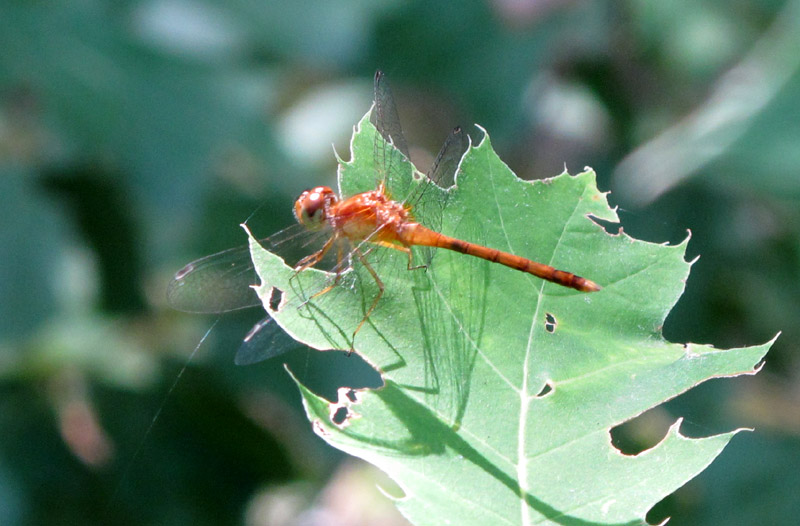
There weren't too many dragonflies around but I did manage to take a photo of this Common Whitetail ( Libellula lydia).


On one of the plants by the stream I found these eggs with tiny nymphs crawling about.
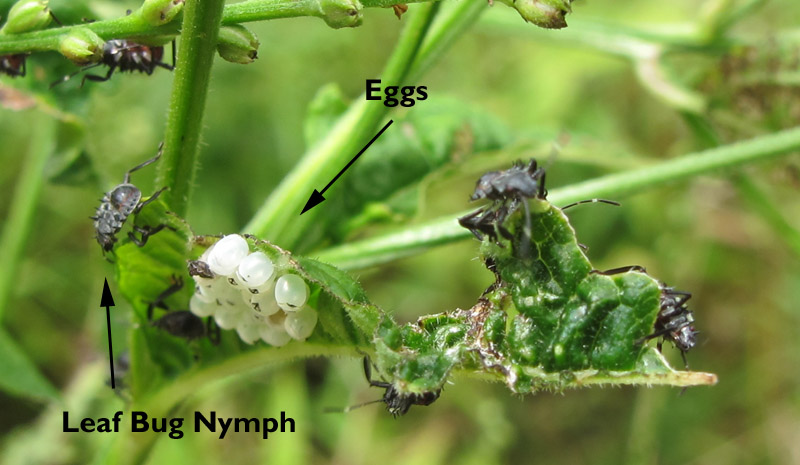

The egg cases were interesting. Notice that black outline of two triangles side by side, surely that is a diagnostic characteristic.  They looked like little leaf footed bugs from the way their legs were shaped even at this young age and I labeled the photo as such but I have since changed my mind and decided they are Brown Marmorated Stink bugs (Halyomorpha halys) like the ones that have been invading our homes these last couple of winters. It in an invasive insect and first reported in Allentown, Pennsylvania in 2001 and now it has spread to surrounding states.


As I walked on up the hill I began to look for leaf rolls to open up. Inside this one I found a Green Stink Bug (Acrostemum hilare).  I sure didn't expect that.


Hummmm...what is in this one? There is really a lot of leaf damage. I work in the city and I never see damage like this on the leaves but out here in the wilds of West Virginia the trees are full of holes and evidence of insects feeding.


I try to open these slowly and carefully so I don't disturb the critter too much. At first I just peaked into the end to see what was there.  Look at the antenna on this critter, they are folded back on themselves. Looks like this is the rear end.  Then it rattled in the leaf roll almost causing me to let go.


Since that strategy didn't scare me away it turned around to take a peak.  Ah ha! I've seen this before.


The night before I found one of these at my porch light when I was taking photos of moths. I hadn't really given it much thought until I found it rolled up in this leaf except for the fact that it had really really long antennae which is about five times the length of its body. It is a Leaf rolling Cricket (Camptonotus carolinensis). They form a flap which is folded over and pulled down with its legs and then from silk glands in its mouth it seals the edges shut.  They hide here during the day and come out to feed at night.  The females crickets have ovipositors that are upturned over it's back. They are wingless or to use a fancy word they are apterous.  They are also the only species of Gryllacrididae (raspy crickets) found in the U.S. So that was my new insect, not particularly pretty but certainly interesting.


Above is the one on my deck. I read that it likes to eat aphids at night but it might have trouble getting past this ant on guard at a nearby burr.


Just as I turned off the road onto the Jimmy Vardis trail I spotted two evergreen bag worms on two different trees. This one let me take a photo before it sunk back in and closed the top tightly. It was almost the size of my thumb. I went back later and they were completely gone. 


Fork-tailed Bush katydid (Scudderia furcata) hiding in plain sight.


This Spicebush Caterpillar was probably the find of the day.  I just happened to notice it on a low plant on my way back to the car.  It had probably crawled from the spice bush on the other side of the trail to this plant and was now in the process of turning into a chrysalis. 


Here is a top view where you can see those large fake eyes it is known for.  Below you can see it's round little head and the sling (see arrow) it has made to secure itself to the stem.  I stayed and watched for a while but nothing was happening except that my stomach was growling, so I left it in peace after taking a dozen or more photos.

Enjoy more outdoor adventures at Camera Critters.

Wednesday, August 18, 2010

Afternoon with insects

A few weeks ago I took a trip up to Sleepy Creek Wildlife Management Area just to see what I could discover.  After the Nature Leadership Training course I have been very aware of insects so it is no surprise I found lots of them. But I was surprised to see the variety and a couple of new ones for me.
On the road leading to the lake I made a couple of stops to take photos of the butterflies. This year we seem to have an abundance of Eastern Tiger Swallowtails and I never tire of looking at them.

Eastern Tiger Swallowtail --Papilio glaucus

Silver-Spotted Skipper (Epargyreus clarus) is the largest skipper in my area. Here it is nectaring on thistle.

I saw a few of these metallic colored Dogbane Beetles (Chrysochus auratus). They look even shinier than in this photo.

Here is a member of the Diptera family, a Bee fly.  It was mimicking a bee but I wasn't fooled.


That bright orange insect is a day flying moth.  It also flies at night and often comes to my porch light. It is an Ailanthus Webworm moth (Atteva punctella).  The larval form feeds on Ailanthus (Tree of Heaven).


This cove on Sleepy Creek Lake is one of my favorite spots.  I have even seen beaver here and countless numbers of dragonflies. Today I found a couple of new insects.

Hummmm....what is inside this leaf roll?

When I opened it up this walking stick like insect quickly crawled out. Eventually it settled down and aligned itself with the mid-vein of this leaf  thinking it was hidden from view. I didn't get a good photo but it actually laid down on the vein and drew its legs to its sides and pointed the antenna forward. I probably wouldn't have noticed it if I didn't see it crawling around first.  This is an assassin bug in subfamily Emesinae of the Reduviidae family. The common name is Thread Legged Bug. 


Aphids but something is missing...ants.  I don't recall ever seeing aphids without ants nearby.  Ants guard aphids and in turn sip the honey dew that they excrete.  Below is a close up that I took through my hand lens and you can see the tiny drops just waiting to be harvested.  I wonder what happened to the ant colony.


I just finished reading E.O. Wilson's novel Anthill and I wondered if the ants that usually farm these aphids were taken over by a super colony as described in his account of the demise of the Trailhead colony.  Without ants taking the honey dew I am curious to know what will happen to these aphids and all that liquid at the end of their butts.

 
Dragonflies were all about. This one is a Yellow-legged Meadowhawk - Sympetrum vicinum.


Another rolled up leaf brought this spider to my attention. 


It is a Paraphidippus aurantius female spider and the very bright orange and metallic green is caused by iridescent scales. They are not very common and usually found in folded leaves like this one.  I chased it all around the the leaf trying to get a photo and it did not drop down to the ground like most spiders do. I suspect this one had eggs inside the leaf that it was guarding.  I also think it was eating.


This little critter crossed my path as I was leaving the banks of the lake.  It is a Spring Peeper and was blending in very nicely.  If I hadn't seen it hop I would never have found it. I can't even imagine all of the critters that was watching me that I wasn't even aware of.

See more nature at Outdoor Wednesdays.


Friday, September 25, 2009

Discovering Moss

My nature writing book group has been reading Robin Wall Kimmerer’s Gathering Moss: A Natural and Cultural History of Mosses and last weekend we decided to go on our own moss walk. I knew where to locate a variety of mosses but not what species they were. The five of us gathered along the Shenandoah River in the Shannondale Springs Wild Life Management Area (SSWMA) parking lot. Right off the bat we found cold bees sitting on wingstem (Verbesina alternifolia) a member of the Asteraceae (Aster family). They were waiting for the air to warm up and to begin sipping nectar and doing the important job of pollination.

Long-tongued bumblebees along with butterflies, wasps and flies visit wing stems. It is also a host plant for Silvery Checkerspot butterflies (Chlosyne nycteis).


The common name came from the side wings on the stems. Once you see you will most likely remember the common name.


Another flower we found at the edge of the parking lot was White Campion. Trillium remarked that she remembers this common name because it looks like it is carrying a pack of supplies for a CAMPing trip at the base of the flower. I thought that was a good little trick to help remember. I thought of the BBC mystery series Campion adapted from the writing of Margery Allingham that I love to watch. He would always place one in his lapel.


Our final destination was the Rolling Ridge Foundation, next to SSWMA, where we set up a table and small portable microscope. We found about 10-15 different species of moss. With hand lens and the microscope we marveled at the different structures of each one.

Broom Moss – Dicranum scoparium


Fern Moss --Thuidium

I was particularly impressed with one that had twisted peristome and brought a sample home to look under my more powerful scope. I think it is in the family Tortula but I am not certain.

Peristome is a combination of the Greek words peri, meaning around and stoma, meaning mouth. So in mosses there is a little cap like an elf’s cap that is attached to the tip of the operculum (the brown stems that shoot up from the moss). When the spores are mature that tip falls off and you can see the opening called the stoma. If you look closely with a hand lens you can see that the opening is surrounded by peristome with teeth. Most of the teeth are short but in the case of the Tortula they were long and twisted. Way cool.


Down by the creek I spotted a female walking stick. It was the first female I have ever seen and had it not been walking I surely would have missed it. 

We also found lots of funnel web weavers (see Trilliums Travels) and a few mushrooms.


On the way back to the car a stick with weird insect stuff was brought to my attention. I brought it home to get a better look and I’m guessing they are Woolly Aphids a member of the Aphibidae family in the order Hemiptera.

It was a joy to spend the morning with fellow Master Naturalist making discoveries in our neck of the woods.


Friday, July 10, 2009

Aphid: their friends and foes


From a distance they look like a mass of speckles on the stems, but when approached and a close look is made, tiny insects can be seen. They are one to ten millimeters long and often you can see more than one size on a stem. They are aphids, in the super family Aphidoidae, of the order Hemiptera.
I have seen red, yellow, orange, green and black ones. Out of the 1,375 species currently identified I wouldn’t be surprised to see shades of blue or purple. Even with soft bodies, the bright colored aphids don’t seem to make any effort to hide. The tiny insects certainly don’t run away when approached. Rather, aphids will all shift from one foot to another, like the wave flowing across the stadium during a football game. Teasingly I have moved my finger close just for the fun of watching them move

Once in a while I will come across an aphid with wings. According to Wikipedia, “when host plant quality becomes poor or conditions become crowded, some aphid species produce winged offspring, “alates,” that can disperse to other food sources.” Imagine if humans could do that! It would be a different world indeed.


One of the most interesting things about aphids is their mutualistic relationship to ants. The ants sip up the discarded sap called “honeydew” from the aphids’ recta. Sounds gross until you consider the fact that we love to eat bee spit mixed with flower nectar and call it honey. Milking the “ant cows” is a common way of describing how the ants stroke the aphids with their antennae to stimulate release of the excess sap, rich in carbohydrates. In turn the ants act as protectors against other insects that would devour them or use their bodies as baby incubators, like the black aphid parasitic wasp (Aphidius rhopalosiphi). A common predator is the Lady Beetle (Coccinellidae) often brought in as the hired gun to rid the garden of these plant suckers. The most effective predator, so I’ve read in Sue Hubble’s book, Broadside and Other Orders, is the Green Lacewing larvae (Chrysopidae). It can eat up to 200 aphids in a week.


Aphids are considered an agricultural pest and something to rid ourselves of, but I find them fascinating to watch and study. Sometimes our foes are not as awful as we imagine.