Showing posts with label nymph. Show all posts

Wednesday, January 19, 2011

Damselfly nymph in winter


At the end of October I took a walk to Altona Marsh and collected some of the water along the track.


I just filled up two plastic peanut butter jars and made sure I had some duckweed, algae, sediment from the bottom and bits of other stuff. I didn’t really look to see what I had. With two jars I was sure to get something interesting.
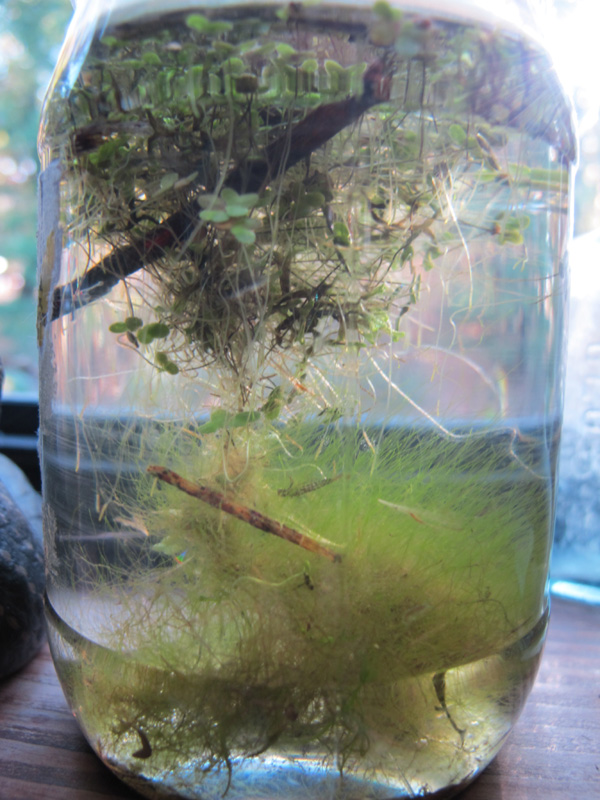
Sure enough, after the water settled for a few hours I was able to see an Odonata nymph. The three leaf-shaped gills extending from the hind end of the body indicates that it is a damselfly. I haven’t a clue what species this is. They overwinter as nymphs and emerge in late spring. They are very predacious and eat every kind of aquatic insect, small crustaceans and snails so I think there will be plenty of food in this one jar for a while. I have actually seen a few things disappear since March and I suspect this is the culprit. Most of the time it just sits and waits for a victim to come by.

I soon realized that I was going to get distorted photos from the jar so I bought a small rectangular plastic tank which made it easier to get close up with my camera. Just recently I took the photo below. I think it must have molted because it is so clear and you can see the insides. Earlier it was emerald green. They molt between 6-15 times. With each instar the nymph get darker in color. Now you can clearly see the tracheal gills and tracheae and lines with the consequent flowing of the blood throughout. I think the darker part in the middle is its heart.


You might be able to make out the labium that looks like its chin. When it is ready to catch something the labium flies out with the swiftness of a frogs tongue and grabs it’s pray and snaps it back into its mouth. I watched it stick part of it out and place its front legs up as though it were cleaning the tip. I wasn't quick enought to get a photo but here is another view.


When I turned the container around it would bend its body to move the tail in my direction. I wonder if that was some sort of defense action. It did it several times.


They move about slowly by crawling or swaying like a fish by sweeping their tail from side to side. It has been really fun to watch especially as the snow falls.

Check out other blogs about water at Watery Wednesday.

Tuesday, August 31, 2010

A new find on the Blue Ridge Tract trail

I took this hike during the latter part of August and even thought a bit of time has passed I still wanted to share what I saw because one of the species was new to me and I thought interesting.  My walk started like any other as I went down the fire road headed toward the wetland area.


I saw several Zabulon Skippers (Poanes zabulon).


Zabulon Skipper, Poanes zabulon


I also found this Red Spotted Purple butterfly (Limenitis arthemis) that looked fresh like it had just emerged.


There weren't too many dragonflies around but I did manage to take a photo of this Common Whitetail ( Libellula lydia).


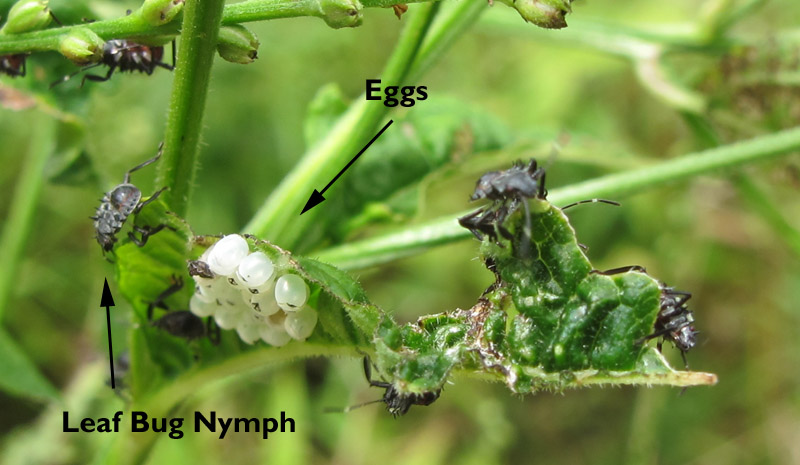
On one of the plants by the stream I found these eggs with tiny nymphs crawling about.


The egg cases were interesting. Notice that black outline of two triangles side by side, surely that is a diagnostic characteristic.  They looked like little leaf footed bugs from the way their legs were shaped even at this young age and I labeled the photo as such but I have since changed my mind and decided they are Brown Marmorated Stink bugs (Halyomorpha halys) like the ones that have been invading our homes these last couple of winters. It in an invasive insect and first reported in Allentown, Pennsylvania in 2001 and now it has spread to surrounding states.


As I walked on up the hill I began to look for leaf rolls to open up. Inside this one I found a Green Stink Bug (Acrostemum hilare).  I sure didn't expect that.


Hummmm...what is in this one? There is really a lot of leaf damage. I work in the city and I never see damage like this on the leaves but out here in the wilds of West Virginia the trees are full of holes and evidence of insects feeding.


I try to open these slowly and carefully so I don't disturb the critter too much. At first I just peaked into the end to see what was there.  Look at the antenna on this critter, they are folded back on themselves. Looks like this is the rear end.  Then it rattled in the leaf roll almost causing me to let go.


Since that strategy didn't scare me away it turned around to take a peak.  Ah ha! I've seen this before.


The night before I found one of these at my porch light when I was taking photos of moths. I hadn't really given it much thought until I found it rolled up in this leaf except for the fact that it had really really long antennae which is about five times the length of its body. It is a Leaf rolling Cricket (Camptonotus carolinensis). They form a flap which is folded over and pulled down with its legs and then from silk glands in its mouth it seals the edges shut.  They hide here during the day and come out to feed at night.  The females crickets have ovipositors that are upturned over it's back. They are wingless or to use a fancy word they are apterous.  They are also the only species of Gryllacrididae (raspy crickets) found in the U.S. So that was my new insect, not particularly pretty but certainly interesting.


Above is the one on my deck. I read that it likes to eat aphids at night but it might have trouble getting past this ant on guard at a nearby burr.


Just as I turned off the road onto the Jimmy Vardis trail I spotted two evergreen bag worms on two different trees. This one let me take a photo before it sunk back in and closed the top tightly. It was almost the size of my thumb. I went back later and they were completely gone. 


Fork-tailed Bush katydid (Scudderia furcata) hiding in plain sight.


This Spicebush Caterpillar was probably the find of the day.  I just happened to notice it on a low plant on my way back to the car.  It had probably crawled from the spice bush on the other side of the trail to this plant and was now in the process of turning into a chrysalis. 


Here is a top view where you can see those large fake eyes it is known for.  Below you can see it's round little head and the sling (see arrow) it has made to secure itself to the stem.  I stayed and watched for a while but nothing was happening except that my stomach was growling, so I left it in peace after taking a dozen or more photos.

Enjoy more outdoor adventures at Camera Critters.

Wednesday, March 18, 2009

What is this bug?


Saturday, March 14, I was participating in a nature walk with a class at the National Conservation Training Center when my friend, Ellen, showed me a stink bug that she had found. I was surprised to see it because of the cold weather. After over wintering, adult females look for host plants in early spring to deposit their eggs and I guess this one was getting an early start. They can be found along field borders, particularly along tree lines near their over wintering sites. Ellen brought it to me, thinking I might know the name, since I am interested in insects. Fortunately for me it was a (Acrosternum hilare), I knew by the common name of Green Stink Bug. So many times, with stink bugs, I am clueless.

The shield like shape (five cornered) was my first clue that it was a stink bug. The second was the way the two pair of wings crossover its back forming an “X”, a characteristic of the Order Hemiptera. Stink bugs are true bugs belonging to the family Pentatomidae from the Greek "pente" (five) plus "tomos" (a section); a reference to the 5-segmented antennae.

They certainly deserve the common name stink bug because if you kill one, the smell is unmistakable. When I have pinned them for my collection, the smell makes me nauseous and lingers on for days. It discharges a smelly substance from two large glands on the bug’s thorax. Many predators spit out stink bugs right after biting into them, so it must work as a good defense.

Ellen let it go but I picked it up again because there was just so much more to see and learn. I had a moment to show someone else how cool insects were and didn’t want to let it pass. I rolled it over onto its back and it patiently laid there while I tried to point out the beak, which I wrongly called a stylus. The correct term is rostrum. They don’t have chewing mouthparts, but they do have a hypodermic-needle-like mouth with four thin, sharp needles in it. They pierce developing seeds, buds, stems and foliage to suck up the juice from plants. When not eating, green stink bugs hold their rostrum underneath their bodies between their front legs and this is what I was trying to point to. The next time I see one I am going to try to watch it feed, follow it around and see what it is up to. Should be fun.

The photos were all taken by me last year and the one on the bottom is a Green Stink Bug nymph. You can find more of my stink bug photos at: http://adventuresinnature.shutterfly.com/